We provide daily dive trips and dive courses around Mabul, Sipadan and Semporna area.
Looking for tips and tricks about diving, marine life or what to do in Borneo? Follow us on our blog for weekly updates from the team!







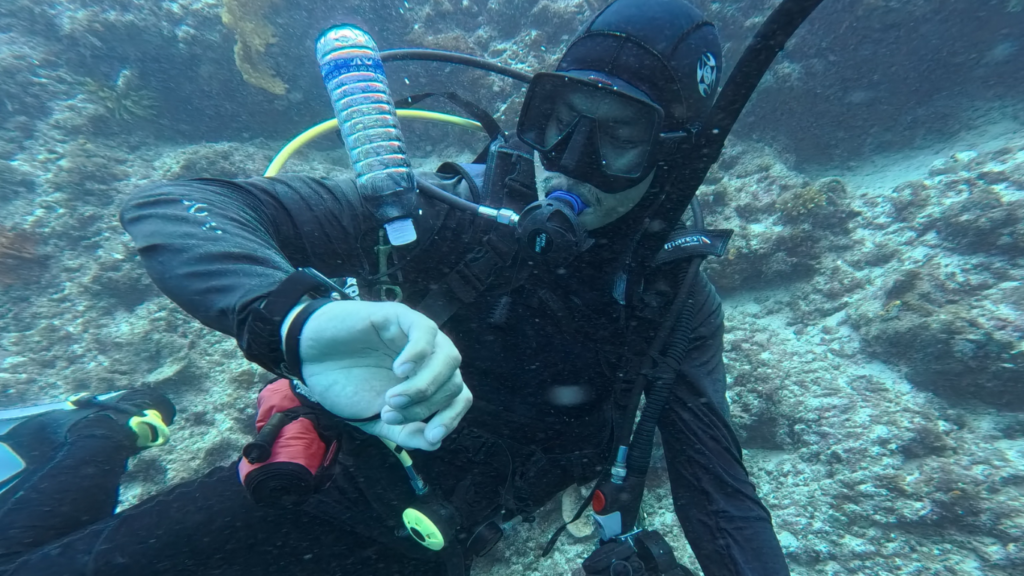
You’re diving along a beautiful reef. Visibility is amazing, the current is gentle, and then suddenly a shark appears out of the blue. Everybody stops to admire it. You’re completely focused on the encounter when your dive computer starts making noises you’ve never heard before.
Beep. Beep. Beep.
You look down at the screen and something is flashing. Unsure what it means, you swim over to your guide and show him the computer. He takes a quick look, gives you an OK sign, and starts leading the group slightly shallower.
A minute later, the alarm stops.
Back on the boat, you ask your guide what all the beeping was about.
“You were getting close to your no decompression limit,” he says.
You vaguely remember hearing about it during your Open Water course. Maybe it came up again during Advanced Open Water. But if you’re like most recreational divers who only dive once or twice a year, the details are probably a little fuzzy.
So let’s start from the beginning.
A no decompression limit is the maximum amount of time you can spend at a certain depth and still be able to make a normal ascent directly to the surface.
This is where many divers get confused because they mix up safety stops and decompression stops.
A safety stop is the three-minute stop most recreational divers make at around 5 meters before surfacing. It is recommended because it adds an extra margin of safety and helps your body release nitrogen more gradually.
A decompression stop is completely different.
A decompression stop is mandatory. It means your body has absorbed enough nitrogen that you cannot safely ascend directly to the surface anymore. You must stop at specific depths for specific amounts of time to allow your body to release that excess nitrogen safely.
As recreational divers, we plan our dives so we stay within the no decompression limit and avoid mandatory decompression stops altogether.
Before we make this simple, let’s understand what is actually happening inside your body.
As you descend underwater, pressure increases. At the surface, you are under one atmosphere of pressure. At 10 meters, you are under two atmospheres. At 20 meters, three atmospheres. At 30 meters, four atmospheres.
Surface (0m) = 1 ATA 🎈
10m = 2 ATA 🎈🎈
20m = 3 ATA 🎈🎈🎈
30m = 4 ATA 🎈🎈🎈🎈
40m = 5 ATA 🎈🎈🎈🎈🎈
The balloons represent the increasing amount of nitrogen being pushed into the body’s tissues as pressure increases.
As the pressure around you increases, more nitrogen from the air you breathe dissolves into your blood and tissues. Nitrogen itself is not dangerous. In fact, about 78% of the air we breathe is nitrogen.
The issue is that the deeper you go and the longer you stay there, the more nitrogen your body absorbs. Your dive computer continuously calculates this process and estimates how much nitrogen is accumulating in your tissues.
The no decompression limit is essentially your computer’s way of saying:
“You still have enough time to ascend normally.”
Once you get too close to that limit, your computer starts paying attention. If you exceed it, the computer will ask you to make decompression stops before surfacing.
Let’s forget the science for a moment.
Imagine opening a bottle of soda. While the bottle is sealed, the pressure keeps the gas dissolved in the liquid. Open it too quickly and bubbles appear everywhere.
Your body behaves in a similar way. At depth, pressure keeps nitrogen dissolved inside your tissues. As you ascend, the pressure decreases and that nitrogen needs to leave your body gradually.
Here’s another example that divers often find easier to visualize.
Imagine a sponge sitting under a running tap. The longer it stays under the water, the more it absorbs. Your body works in a similar way with nitrogen. A shallow dive is like a sponge that gets slightly wet. A deeper and longer dive is like a sponge that becomes completely saturated.
When you ascend, your body needs time to “squeeze out” that nitrogen safely. The more nitrogen you’ve absorbed, the more careful you need to be.
The no decompression limit exists to make sure you never absorb so much nitrogen that special decompression stops become necessary.
One of the main goals of recreational diving is simplicity.
If something unexpected happens underwater, recreational divers should be able to begin a controlled ascent and safely reach the surface without additional decompression obligations.
Technical divers are different.
They intentionally conduct decompression dives, but they also receive specialized training, carry additional gas supplies, use redundant equipment, and plan their dives in much greater detail.
A recreational diver who accidentally exceeds the no decompression limit may suddenly find themselves in a situation they were never trained to manage.
That is why staying within your NDL is such a fundamental part of recreational dive planning.
Imagine you’re on the fourth day of a dive trip. The visibility is incredible, the reef is full of life, and before you know it, you’ve spent longer at depth than you intended.
Suddenly your computer displays a decompression obligation.
At first glance, it may not seem like a big deal. After all, it’s only a few minutes.
But now imagine your air supply is already lower than expected. Perhaps there is a current. Maybe your buddy is also getting low on gas.
That decompression stop is no longer just a number on a screen. It becomes a critical part of the dive.
This is one of the reasons recreational divers are taught to avoid entering decompression. It’s not only about nitrogen. It’s about maintaining options and having enough margin to deal with the unexpected.
One thing many new divers notice is that experienced divers often seem more conservative than beginners expect.
They don’t stay at the deepest part of the dive until the last possible minute. They don’t race their NDL countdown. They don’t treat their dive computer like a challenge to beat.
Instead, they leave themselves room for error.
They know that fatigue, dehydration, repetitive dives, currents, and even individual physiology can influence how the body handles nitrogen.
Their goal is not to squeeze every possible minute out of a dive.
Their goal is to enjoy thousands of dives over many years.
The next time your computer starts beeping while you’re admiring a shark, you’ll know it isn’t trying to ruin the moment.
It’s simply reminding you that your body has limits.
The no decompression limit is one of the most important safety tools in recreational diving. It helps divers manage nitrogen absorption, stay within their training, and maintain enough flexibility to deal with unexpected situations.
The more you understand what your dive computer is telling you, the better decisions you can make underwater.
And better decisions lead to safer, more enjoyable dives.
Have you ever had your dive computer start beeping unexpectedly underwater? Let us know what happened in the comments.
A no decompression limit is the maximum amount of time a diver can stay at a certain depth and still ascend directly to the surface without mandatory decompression stops.
No. A safety stop is recommended and adds an extra margin of safety. A decompression stop is mandatory when a diver has absorbed too much nitrogen to ascend directly to the surface.
Recreational diving is planned around staying within no decompression limits. Intentional decompression diving requires additional training and falls under technical diving.
The deeper you go, the more pressure you are under and the faster your body absorbs nitrogen.
The risk is very low, but no dive is completely risk-free. Factors such as hydration, fatigue, repetitive diving, and individual physiology can influence risk.
The warning gives you time to adjust your depth or begin ascending before you enter decompression obligations.