

Before the first tank reaches the boat, Mabul is already awake.
The light begins to move across the water, the restaurant fills with people making coffee, and the jetty slowly becomes the centre of everything. Tanks appear from the compressor room. BCDs and regulators are organised. Guides check their groups while divers try to remember whether they left their camera battery in the room.
This is the beginning of a normal dive day in Mabul. It is organised, busy and full of small moving parts, but it rarely feels formal. You are barefoot on an island, breakfast is beside the sea, and whatever the schedule holds, you know most of the day will be spent underwater.
Breakfast opens early enough for the first dive groups, with tea and coffee available for those who need a little help becoming functional humans. Because the rooms, restaurant, dive centre and jetty are all part of the same beachfront resort, there is no morning commute and no vehicle transfer. You walk from breakfast to the dive centre in a few minutes.
By the time you arrive at the jetty, much of the preparation has already happened behind the scenes. The team has organised the tanks and group equipment, but every diver still checks their own setup, confirms weights and makes sure personal equipment is ready. Your guide then explains the site, expected conditions, route, depth, safety procedures and the marine life you may encounter.
A good briefing does more than tell you where to swim. It helps everyone enter the water knowing how the dive should work, which makes the experience calmer from the beginning.

Mabul is famous for macro life, but describing it only as a macro destination does not quite explain the variety below the surface.
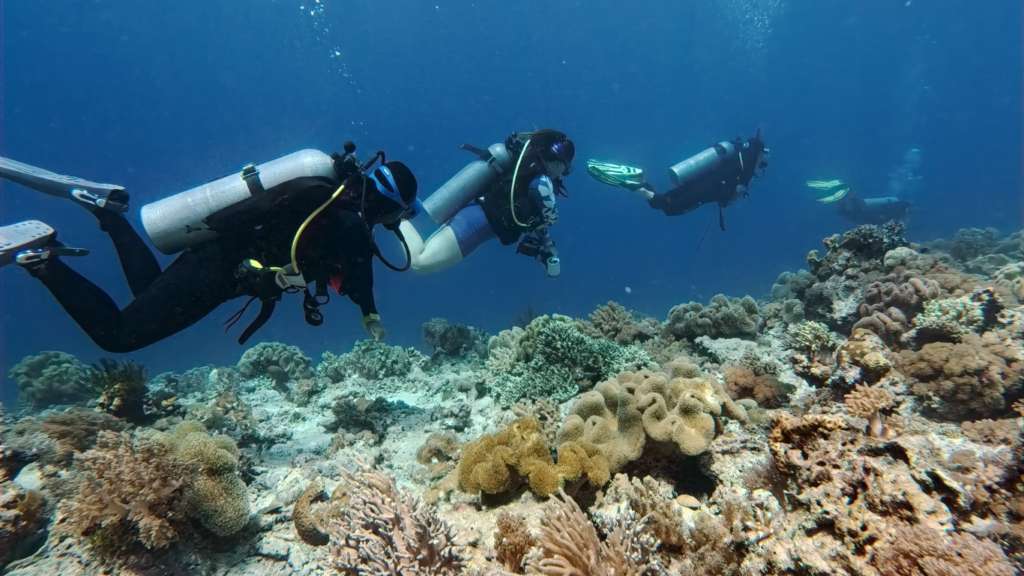
Some sites have artificial structures covered in marine life, with schooling jackfish, eagle rays just on the house reef, large groupers and moray eels moving between them. Other dives follow gentle coral slopes or sandy areas where the most interesting animal in sight may initially look exactly like a rock, a leaf or a piece of algae.
This is where the pace of the dive changes. Instead of swimming quickly in search of something large, the group slows down. Guides check beneath ledges, beside small sponges and across patches of sand. A frogfish appears where nobody else saw it. A ghost pipefish becomes visible only after someone points directly at it several times. Nudibranchs, seahorses and octopus turn a small section of reef into a treasure hunt.
Turtles are also common on a dive day in Mabul, and the contrast is part of the fun. One moment the whole group is focused on a creature smaller than a fingernail. A few minutes later, a turtle passes over the reef as though it has somewhere important to be.
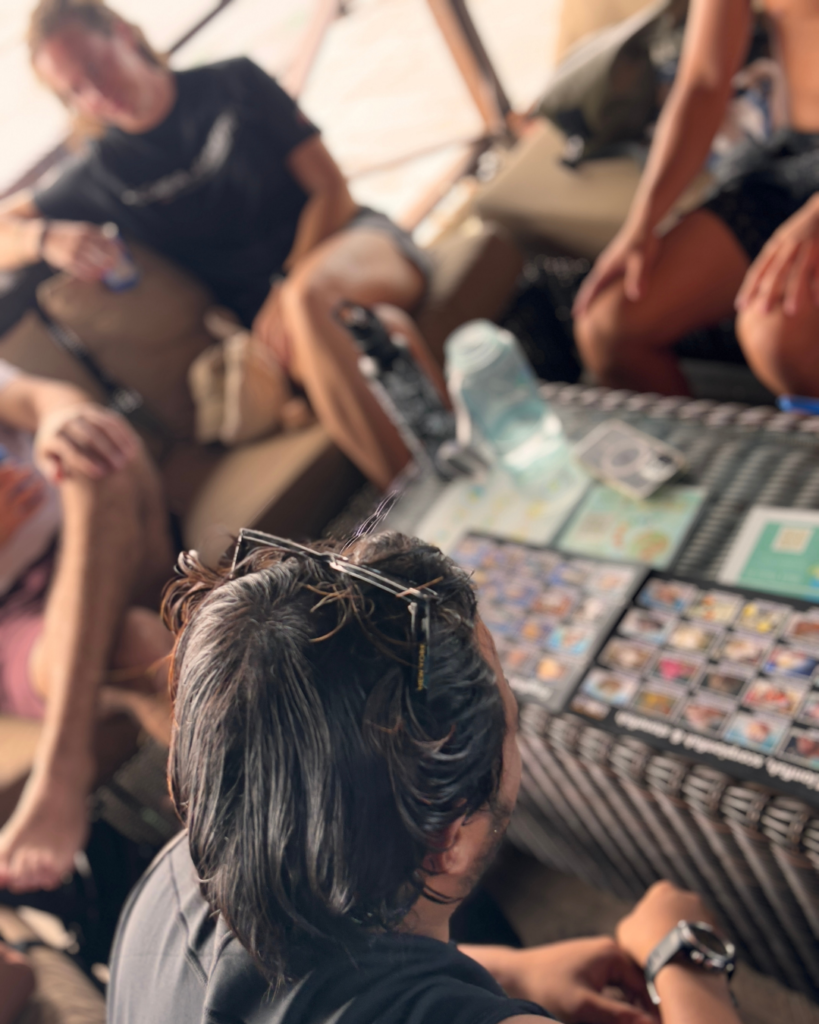
Between dives, everyone returns to the jetty, drinks water and begins comparing what they saw, while the guides change the tanks. This is usually when the animal confidently identified underwater becomes “the yellow thing beside the sponge” until somebody finds it in a fish-identification book.
Morning and afternoon snacks are served at the resort, with tea, coffee and water available throughout the day. Depending on the dive plan and destination, lunch is either part of the trip or enjoyed back at the open-plan restaurant. For guests staying at Mabul Beach Resort, the accommodation is full board, so breakfast, lunch, dinner and snacks are already part of the stay.
The surface interval is also a chance to reset. Cameras are checked, stories are exchanged and divers have time to ask their guide about anything they noticed during the previous dive. The day has structure, but it does not feel rushed.
Scuba Junkie’s dive-and-stay packages include three dives per diving day. Around Mabul and nearby Kapalai, that does not mean repeating the same experience three times.
One dive may focus on an artificial reef filled with fish. The next can become a slow search across a sandy slope for frogfish, pipefish and octopus. Another might follow a coral reef where turtles rest and small creatures hide among the branches.
The sites are close enough that more of the day can be spent diving rather than travelling, but different enough to keep each descent interesting. It is also why several days around Mabul rarely feel repetitive. Conditions change, animals move and guides notice different things each time.
Nothing is guaranteed underwater, of course. That uncertainty is part of diving. But Mabul has a way of making even the quieter dives feel rewarding, especially once you learn to look more carefully.
After the final dive, the jetty fills with rinsing equipment, drying wetsuits and conversations that begin with “Did you see…?” Homemade afternoon snacks appear, logbooks come out and the group gradually separates between showers, rooms, hammocks and the bar.
There is time before dinner to walk along the beach, explore the small island, snorkel over the house reef or simply sit somewhere with a view of the water. Mabul is small enough to walk around in under 30 minutes, and life on the island has a different rhythm once the diving finishes.
Dinner is served buffet-style in the open restaurant. Scuba Junkie does not serve seafood at the resort because of concerns about destructive and unsustainable fishing practices in the surrounding region. The fish stay on the reef, which feels like a fairly reasonable arrangement for a dive resort.
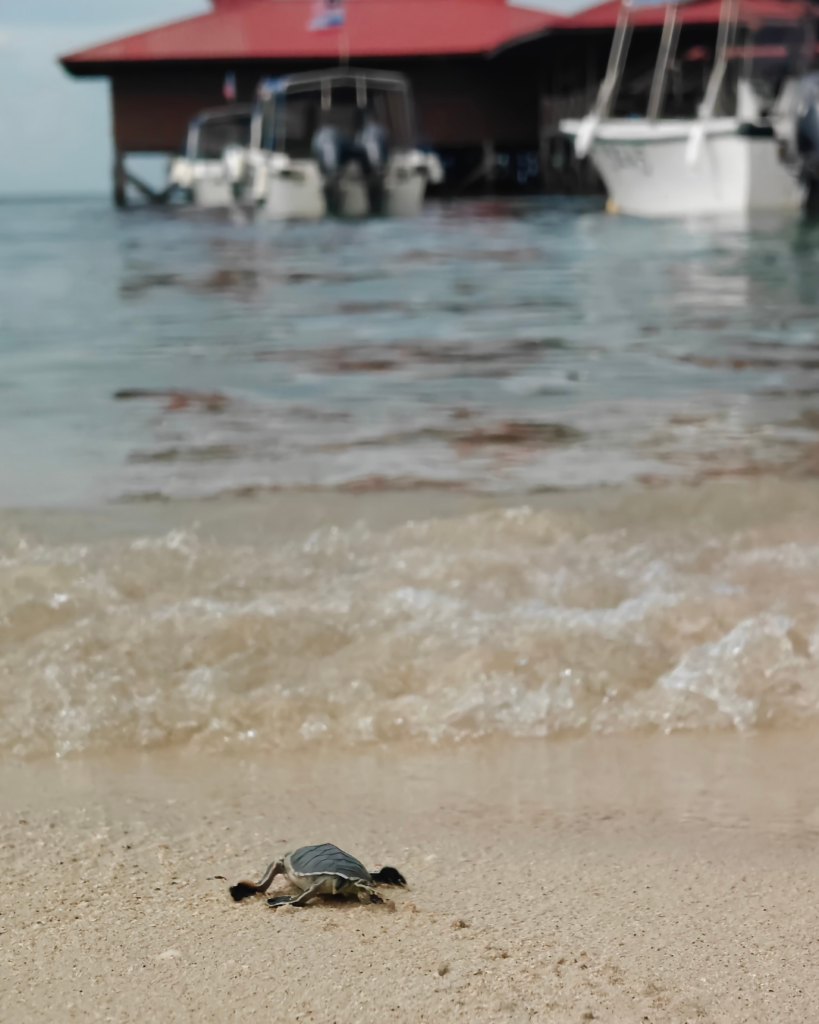
Some evenings may bring a turtle nesting or hatchling release with the SEAS conservation team. On others, the main event is the sunset, a drink at the bar and a table full of divers trying to decide which sighting won the day.
It would be easy to describe adive day in Mabul as breakfast, three dives, meals and sunset. Technically, that would be accurate. It would also miss the part people remember.
The experience is the guide who somehow finds an animal everyone else swam past. It is the boat crew helping before you even realise you need it, the stranger who becomes your dive buddy and the excitement of returning to the jetty with a story the other groups have not heard yet.
Scuba Junkie is a large operation, capable of welcoming many divers, but the day is still built from personal moments. The staff learn what you enjoy seeing. Groups celebrate each other’s milestones. Guests begin recognising the kitchen, dive and resort teams. After a few days, the jetty stops feeling like a departure point and starts feeling familiar.
That is what a dive day in Mabul really feels like. Busy enough to run smoothly, relaxed enough to enjoy, and full of the small moments that make people want to return.
Scuba Junkie’s dive-and-stay packages generally include three dives per diving day. The exact destinations and schedule depend on the package, conditions and operational planning.
Rental equipment is available. For certified fun diving, a dive computer is not included with standard full-equipment rental, so divers should bring their own or ask the booking team about rental options before arrival.
Mabul is known for turtles and macro life such as frogfish, nudibranchs, seahorses, ghost pipefish, octopus and many other unusual small creatures. Artificial reef sites can also hold schooling jackfish, groupers and moray eels. Sightings are never guaranteed, but the diversity makes every dive a search for something different.
Yes. Accommodation at Mabul Beach Resort is full board and includes breakfast, lunch, dinner, snacks, drinking-water refills, tea and coffee. Vegetarian and vegan options are available, and dietary requirements should be shared with the team when booking.
Yes. Scuba Junkie asks guests to use reef-safe sunscreen throughout their stay to reduce the impact of harmful sunscreen chemicals on the surrounding reefs. A hat, UV-protective clothing and avoiding unnecessary sun exposure are also useful ways to protect both your skin and the ocean.
Yes. Scuba Junkie Mabul is a PADI 5 Star IDC Centre offering training from beginner programmes and Open Water certification through continuing education, Divemaster and Instructor-level courses.
Whether you are coming for the macro life, preparing for Sipadan, completing a course or simply looking for several days of varied diving from one island base, Mabul gives the trip a rhythm that is easy to settle into.
Breakfast. Briefing. Three dives. Small creatures, large turtles, new dive buddies and a sunset conversation about doing it all again tomorrow.
To start planning your stay, contact sipadan@scubajunkie.com or WhatsApp +60 19-640 0116.
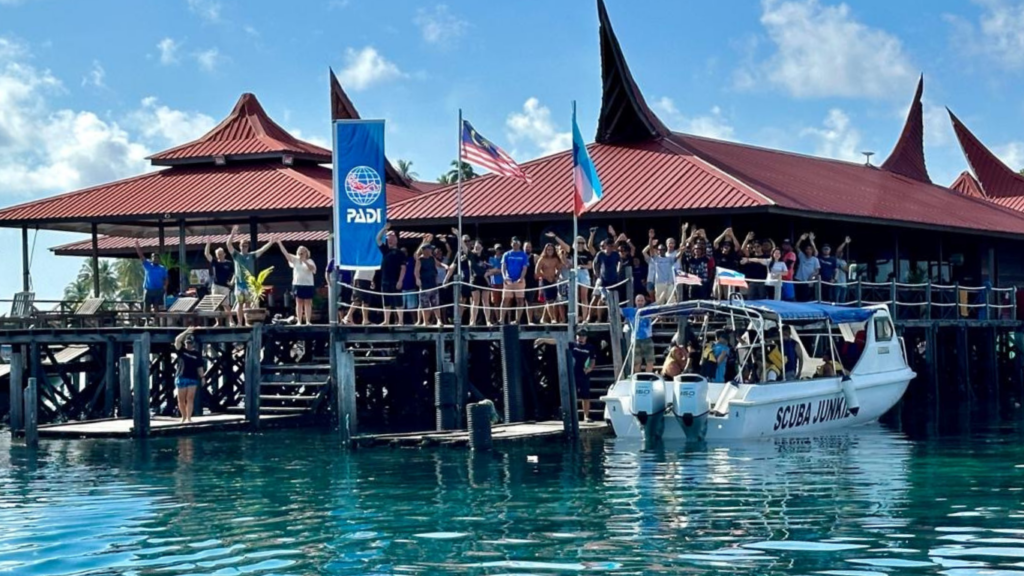
Every dive company has a beginning. Ours started in Semporna in 2004 with one small dive centre, a love for the ocean and a simple idea: great diving should feel welcoming.
There were no multiple locations or beachfront resort at the beginning. There was a team that wanted to share the underwater world of Sabah without losing the relaxed, personal atmosphere that brings divers together. People arrived as guests, spent their days diving, and often left feeling like part of something larger.
More than two decades later, a great deal has changed. Scuba Junkie has grown across Borneo and Indonesia, thousands of divers have joined us underwater, and conservation has become part of daily life at our locations. Yet the feeling behind the company remains remarkably familiar.
This is the story of how a small dive centre in Semporna found a home on Mabul and grew into the Scuba Junkie family we know today.
Semporna has long been the gateway to some of Sabah’s most extraordinary diving. From here, boats travel towards islands and reefs that divers dream about long before they finally see them for themselves.
Scuba Junkie began here in 2004. In those early days, the focus was straightforward: provide safe, high-quality diving with experienced people who genuinely enjoyed sharing it.
That combination mattered. Dive travel can be intimidating, especially when someone is visiting a new country, joining a boat alone or taking their first course. The team wanted the experience to feel organised without becoming impersonal. Serious attention could be given to safety and training while the atmosphere remained friendly, relaxed and fun.
That balance became part of Scuba Junkie’s identity. The diving was the reason people came, but the people were often the reason they returned.
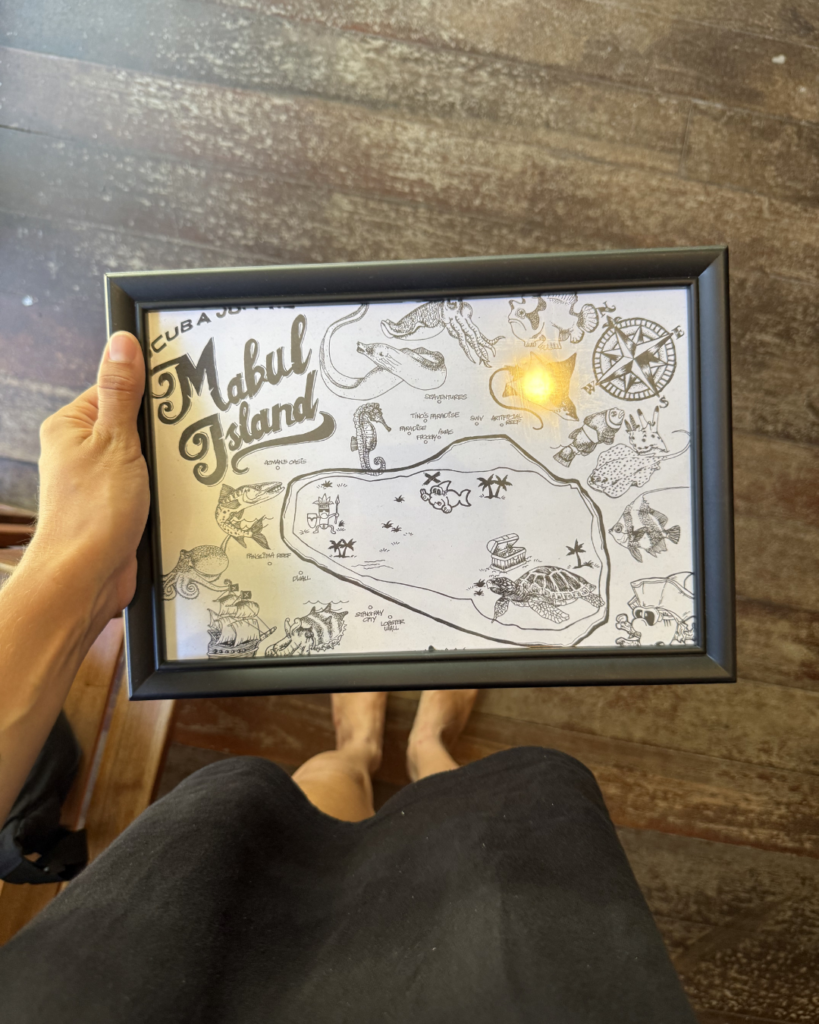
As Scuba Junkie grew, Mabul became the natural next chapter.
The island sits close to Sipadan, but it is far more than a convenient base for reaching a famous dive destination. Mabul has its own rhythm, community and underwater character. Turtles move across the reefs, schooling fish gather around artificial structures, and some of the ocean’s strangest small creatures hide across sandy slopes and coral gardens.
Building a home here allowed the Scuba Junkie experience to become more complete. Today, Mabul Beach Resort brings the accommodation, restaurant, dive centre, jetty, training areas and house reef together in one beachfront setting. Guests can wake beside the water, walk to breakfast and begin their dive day without a morning commute.
It also created a place where people could stay long enough to become part of island life. Dive buddies became friends. Guests got to know the boat, restaurant, resort and dive teams. Instructors watched nervous beginners become confident divers, then sometimes welcomed them back years later for professional training.
Mabul was no longer simply somewhere the boats visited. It became home.
Part of what makes this home so special is the variety surrounding it.
Sipadan offers the kind of diving that can make a diver forget to check anything except the blue. Reef sharks cruise past the walls, turtles appear with wonderful regularity, and schools of fish can seem to take over the entire view. The walls themselves drop hundreds of metres into deep water, giving every dive a sense of scale.
Around Mabul, the pace changes. Divers slow down and search carefully for frogfish, ghost pipefish, nudibranchs, octopus and other small animals that have perfected the art of not being seen. Kapalai brings more of the macro life that underwater photographers and curious divers love, often hidden around sandy areas and structures covered in marine growth.
Then there is Si Amil, which refuses to fit neatly into one category. Rare macro life can be found on the reef, while eagle rays or schooling devil rays may pass through the blue.
Together, Sipadan, Mabul, Kapalai and Si Amil give divers something that is increasingly difficult to find in one trip: genuine variety. Big encounters and tiny discoveries. Dramatic walls and patient searches. Famous sites and unexpected favourites.
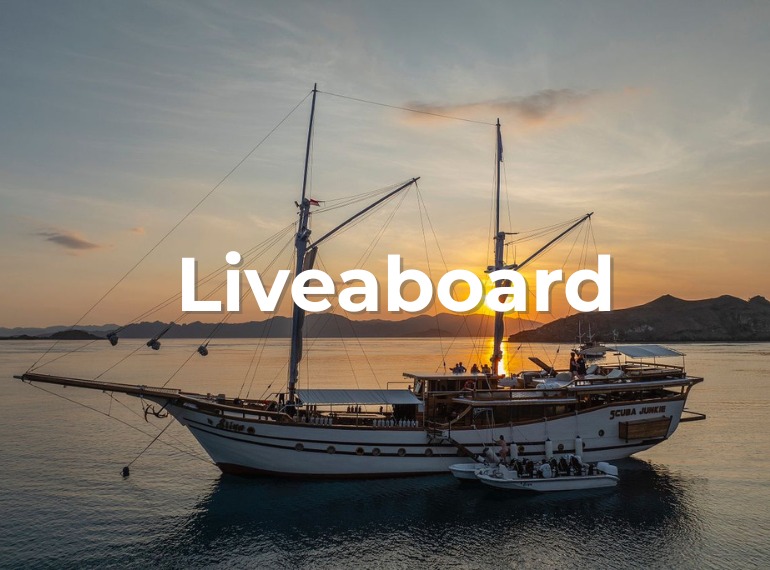
Over the years, the Scuba Junkie name travelled beyond Semporna and Mabul. New destinations followed across Sabah and Indonesia, including Kota Kinabalu, Nusa Penida, Komodo, Sangalaki and liveaboard adventures through some of the region’s most remarkable seas.
Each place has its own marine life, landscape and personality. A day diving from Kota Kinabalu feels very different from a week in Komodo or a trip built around Sangalaki’s manta rays. What connects them is not an attempt to make every location identical. It is a shared way of welcoming people.
The phrase “Scuba Junkie family” is not only about the size of the company. It describes the relationships that form around the dive centre, on the boats and during the quiet moments between dives. It includes the guides who remember what you hoped to see, the crew who make a difficult entry feel easy, the instructors who help you through the skill that worried you, and the guests who arrive alone but rarely feel alone for long.
Once a Scuba Junkie, always a Scuba Junkie. It sounds playful, but after seeing guests return in a new country, at a new certification level or with friends they met on an earlier trip, it also feels true.
Sharing the ocean creates a responsibility to protect it.
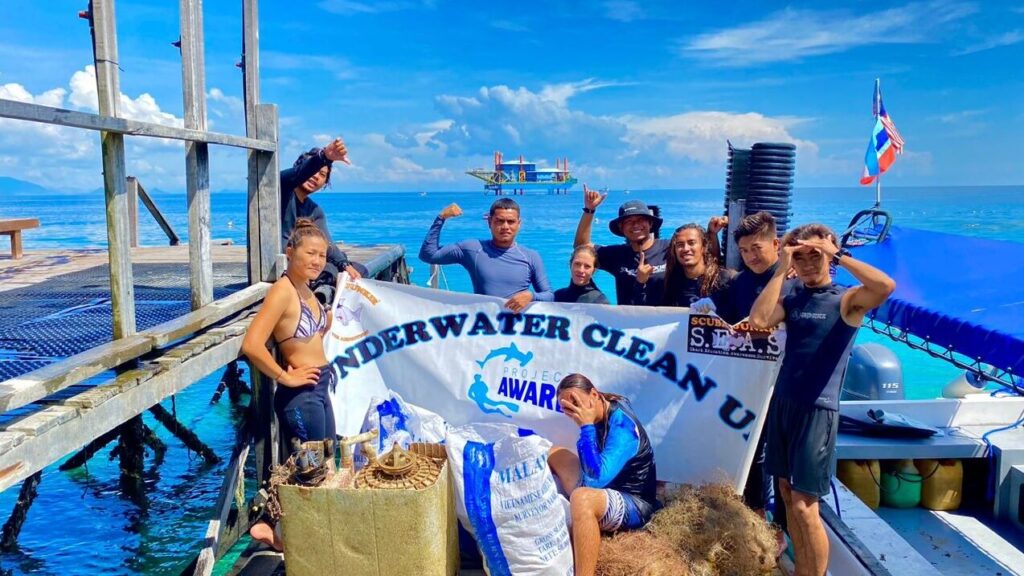
On Mabul, that responsibility is put into action through Scuba Junkie SEAS. The conservation team works across turtle protection and rehabilitation, coral restoration, marine-debris removal, shark research and environmental education. Guests may see parts of this work during their stay, but much of it continues quietly throughout the year.
Turtle nests are monitored and protected. Injured turtles may be cared for through rehabilitation work. Coral nurseries and artificial reefs support restoration and research. Clean-ups remove rubbish from beaches and the sea, while outreach programmes involve local young people, schools, guests and the wider community.
The resort also works to reduce its own impact through measures including solar power, recycling, rainwater repurposing and a seafood-free restaurant. None of these actions means the work is finished. Conservation is not a badge a dive company earns once. It is a continuing process of learning, improving and showing up for the place that makes the entire experience possible.
For Scuba Junkie, the ocean is not only where we work. It is the reason the work exists.
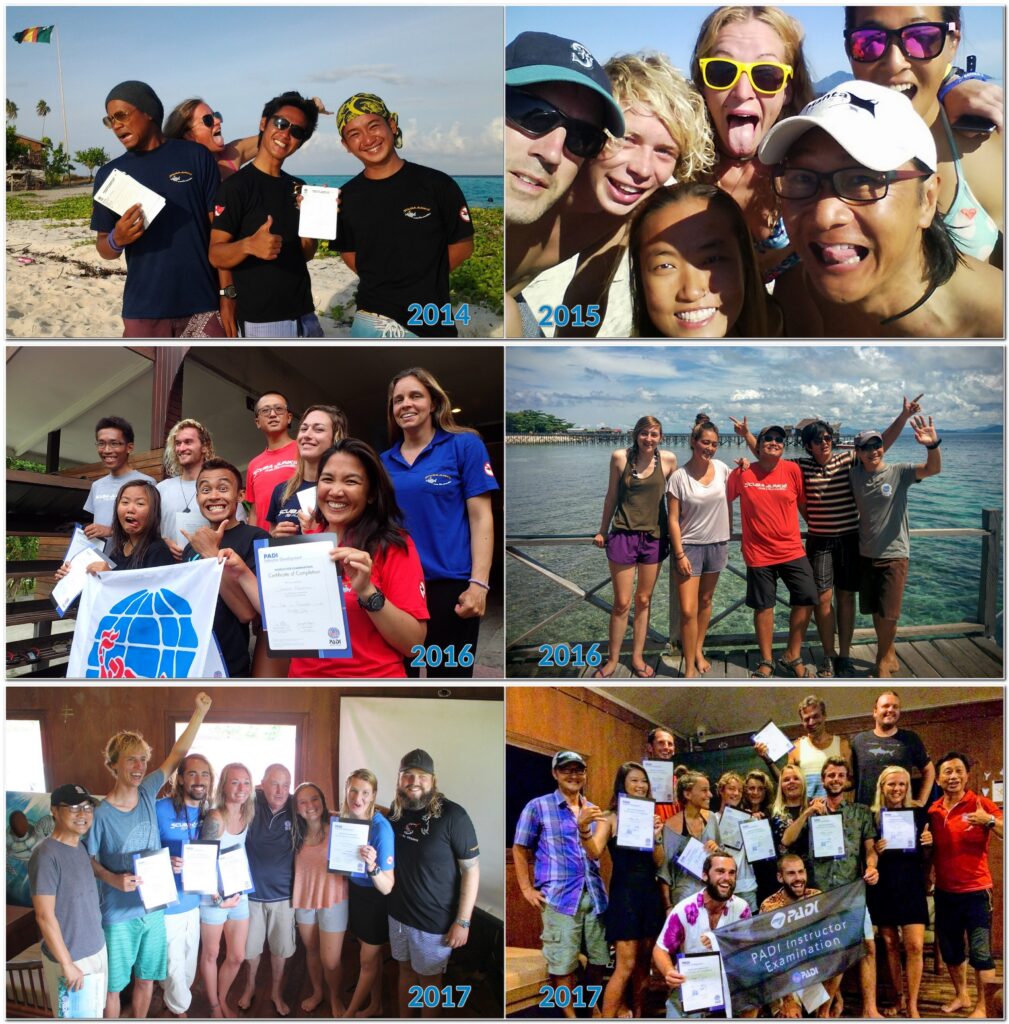
The Scuba Junkie story is also written through thousands of individual diving stories.
For one person, it begins with the strange sound of their first breath underwater. For another, it is the moment they complete their Open Water course or finally feel comfortable after time away from diving. Some arrive hoping to see a shark. Others are happiest spending an hour searching for a creature smaller than their thumb.
And for some divers, a holiday becomes the beginning of a new direction.
As a PADI 5 Star IDC Centre, Scuba Junkie Mabul offers training from beginner experiences through Divemaster and Instructor-level education. Professional candidates do more than collect another certification. They learn how to look after other divers, communicate clearly, demonstrate skills, solve problems and become someone a future student can trust.
That progression captures something important about the company. A person can arrive having never worn a mask and regulator, then return years later ready to guide, teach or build a life around the ocean. The team gets to be part of the journey at every stage.
It would be easy to tell the Scuba Junkie story through dates, locations and numbers. Those details show how much the company has grown, but they do not fully explain why people feel connected to it.
The real story lives in smaller moments.
It is an early morning briefing on the jetty. A turtle appearing beside a new diver. A guide pointing repeatedly at a perfectly camouflaged frogfish while the whole group sees absolutely nothing. A candidate practising the same skill until it finally feels natural. A conservation team releasing hatchlings towards the sea. A table of strangers laughing together over dinner after a day underwater.
Scuba Junkie began with a love of diving and a belief that people should feel welcome while experiencing it. From Semporna to Mabul and far beyond, that remains the heart of the story.
The locations may keep growing. The next chapters may take us to new reefs, new communities and new conservation challenges. But the purpose stays the same: share the ocean, take care of it, and make people feel at home along the way.
Scuba Junkie began in Semporna, Sabah, in 2004. It started as a small dive centre offering access to the world-class diving around the Semporna region.
Scuba Junkie Sipadan is based at Mabul Beach Resort on Mabul Island. Guests stay and dive from Mabul, with packages offering access to destinations that can include Sipadan, Mabul, Kapalai and Si Amil. There is no accommodation for visitors on Sipadan itself.
Yes. Scuba Junkie Mabul is a PADI 5 Star IDC Centre offering beginner experiences, recreational certifications, continuing education and professional courses. The team can help guests choose an option that matches their certification and experience.
Scuba Junkie SEAS is the conservation organisation based on Mabul. Its work includes sea-turtle conservation, coral restoration, marine-debris removal, shark research and environmental education involving guests and local communities.
Yes. Professional training includes the PADI Divemaster course and Instructor Development Course. These programmes combine knowledge development, practical skills and real experience in a working dive environment.
Contact the booking team with your travel dates, certification level, number of logged dives and the kind of diving you hope to experience. They can explain suitable packages, transfers and course options.
Maybe your chapter starts with a first dive. Maybe it begins with Sipadan, a tiny frogfish on Mabul or the decision to become a dive professional.
Wherever you are in your diving journey, there is space for you in the story.
Contact sipadan@scubajunkie.com or WhatsApp +60 19-640 0116 to start planning your time on Mabul.
Let this World Oceans Day remind us that the ocean is not separate from us but has always flowed through us, in everything we do and consume. Discover how small daily actions, responsible diving, and marine conservation efforts by the Scuba Junkie family help protect our blue planet.
The first time many of us truly understand the ocean is not from a documentary or a photograph. It happens quietly. Sometimes underwater, where the sound of the world disappears and all we hear is our own breathing. Sometimes standing barefoot on a beach at sunrise, watching waves arrive from places we will never see.
And sometimes, it happens when we lock eyes with a sea turtle gliding through coral reefs older than human history itself.
That moment changes people.
This is why World Oceans Day matters so deeply to us at Scuba Junkie. Not because it is just another date on the calendar, but because it reminds us that the ocean is not somewhere far away. It is part of every breath we take, every meal we eat, every climate system that keeps our planet alive.
The ocean gives us life long before we ever step into it.
Yet today, it needs our active actions to protect it more than ever. So, let’s reimagine our relationship to the ocean.
We often speak about “saving the ocean” as though it were separate from humanity. But the truth is simpler and more uncomfortable than that. If the ocean suffers, we suffer too.
The ocean is one of Earth’s greatest oxygen producers and the foundation of our planetary life support system. It regulates our climate, feeds over 3 billion people, supports livelihoods, and protects biodiversity on a scale we are only beginning to understand.
And still, every year, millions of tonnes of plastic enter marine ecosystems. Coral reefs are bleaching under rising temperatures. Sea turtles mistake floating plastic bags for jellyfish. Ghost nets continue drifting silently through the sea, trapping marine life long after they were abandoned.
For many people, these problems feel distant. Easy to ignore.
That is part of the challenge.
We rarely protect what we do not feel connected to.
At Scuba Junkie, we have seen this transformation happen thousands of times. Someone arrives simply wanting a holiday or a dive certification. Then they descend beneath the surface for the first time and suddenly the ocean becomes personal.
A turtle is no longer just “marine life.”
A reef is no longer just “nature.”
The ocean becomes a living world they care about deeply.
And once people care, they begin to protect.
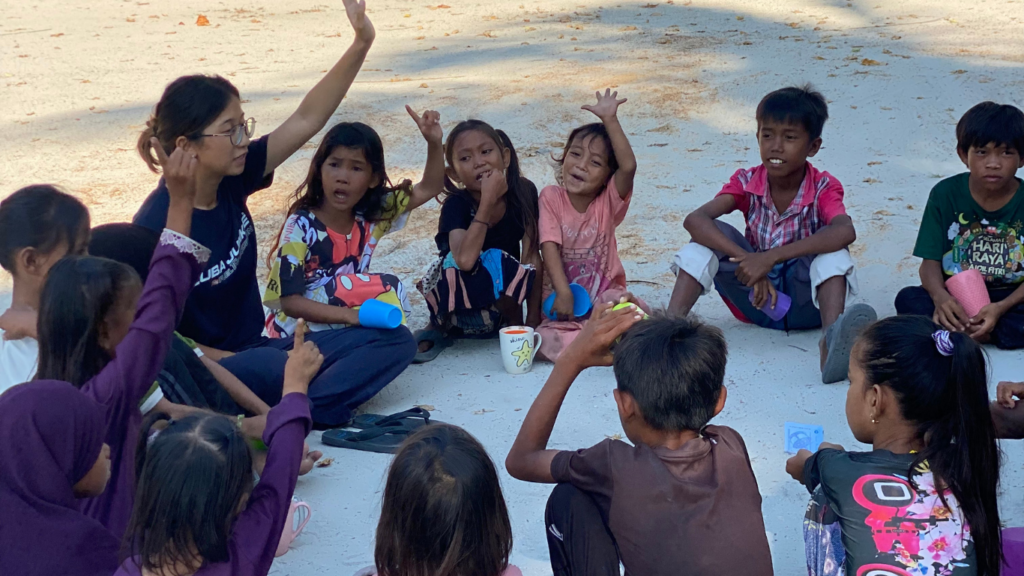
It is easy to feel overwhelmed when talking about protecting and preserving the ocean. Climate change, pollution, overfishing, habitat destruction… the list can feel endless.
But not all hope is lost.
In fact, one of the most beautiful things we witness every day is the incredible resilience of the ocean when people choose to care for it.
Across the Scuba Junkie family, conservation is not treated as a side project. It is part of daily life — from the small details, like providing guests with locally sourced eco-friendly toiletries across all our operations to weekly beach and underwater cleanups to the larger programs that define how we dive, travel, educate, and operate.
Through Scuba Junkie SEAS, our conservation arm founded in 2009, marine conservation has become deeply woven into everything we do. In Mabul, sea turtle nests are protected through hatchery programs that have already helped release more than 17,000 hatchlings back into the ocean. In collaboration with the Sabah Wildlife Department, injured turtles have been rehabilitated and returned to the wild through the Mabul Turtle Rehabilitation Centre.
Coral restoration projects, marine debris initiatives, shark conservation efforts, and educational outreach efforts all work toward the same idea:
Protecting the ocean starts with people.
Not perfect people.
Not scientists only.
Just people willing to care.
This is an important conversation, and one we believe should be honest.
Yes, diving can damage reefs — if done irresponsibly. Poor buoyancy, touching marine life, littering, or overcrowding fragile ecosystems can all have negative impacts.
But when done responsibly, diving and other marine activities can also become one of conservation’s strongest allies.
At Scuba Junkie, responsible dive practices are central to how we operate. Environmental briefings, following the Green Fins code of conduct, reef-safe behaviors, and conservation education are integrated into the diving experience because we believe tourism should protect the places it depends on.
And perhaps even more importantly, diving creates emotional connection.
Someone who has watched a shark glide through blue water is far more likely to support shark conservation. Someone who has seen coral bleaching with their own eyes understands climate change differently. Someone who has floated beside a turtle often leaves carrying a sense of responsibility that lasts years beyond the trip itself.
The ocean stops being abstract.
It becomes real.
One of the biggest misconceptions about marine conservation is believing only coastal communities or divers can make a difference. But the ocean connects all of us and our actions.
The plastic bottle thrown away inland can still reach the sea through rivers and drainage systems. The seafood choices we make influence the fishing industry. The products we buy, the waste we create, the businesses we support — all of these decisions ripple outward and can make a real difference.
Being an ocean ambassador does not require living close to the ocean. It begins with awareness. Sometimes the smallest actions matter more than we realize:
Using reusable bottles and bags to reduce unnecessary plastic consumption.
Supporting sustainable tourism operators such as Green Fins Members.
Learning and sharing about marine ecosystems.
Using non-toxic, reef-safe sunscreens.
Use local and public transportation when possible.
Supporting conservation organizations in-person or financially.
Sharing educational content instead of ignoring it.
Voting for candidates that prioritize climate action.
Even conversations matter. Because awareness spreads. And when enough people care, that’s when systems begin to change.
The truth is that conservation is rarely about one dramatic action. It is usually thousands of small consistent efforts carried out by ordinary people.
At Scuba Junkie, we have watched travelers join reef and beach cleanups during their holidays and leave transformed by the experience. We have seen local communities become deeply involved in turtle protection initiatives. We have watched children release hatchlings into the sea and understand, perhaps for the first time, that nature’s future depends on them.
For those who have the time and would like to be more hands-on, participating in reef and beach cleanups, marine life monitoring, or marine conservation workshops can make a direct difference.
For those who are limited on time and resources, your support can still be powerful. Scuba Junkie SEAS runs programs such as turtle adoption initiatives connected to the hatchery and rehabilitation work in Mabul. Supporting these projects helps fund nest protection, rehabilitation efforts, monitoring, education, and conservation outreach. Many vital marine conservation organisations remain underfunded, any support you can offer makes a difference.
Sometimes helping the ocean means getting in the water.
Sometimes it means using your voice or wallet.
Both matter.
There is a tendency in environmental conversations to focus only on loss. But the ocean is still full of life worth fighting for.
While individual actions matter deeply, we can’t ignore that the future of the ocean also depends on larger decisions being made at government and industry levels. Marine protected areas, stronger regulations against pollution, sustainable fishing policies, and meaningful climate action all play a critical role in protecting marine ecosystems for future generations.
Sometimes helping the ocean means carrying a reusable bottle or joining a beach cleanup. Sometimes it means signing petitions, supporting environmental organizations, voting for leaders who prioritize conservation, or using our voices to demand stronger protection for our seas.
Real change happens when personal responsibility and collective action work together — whether that means carrying a reusable bottle, signing a petition, or voting for leaders who prioritize our seas.
And despite the challenges, hope is not lost.
There are still healthy reefs bursting with color.
There are still turtles returning to the nest.
There are still communities choosing conservation over exploitation.
There are still people willing to dedicate their lives to protecting marine ecosystems.
World Oceans Day is celebrated every year on June 8th to raise awareness about the importance of the ocean and encourage global action to protect marine ecosystems.
The ocean is one of Earth’s greatest oxygen producers, regulates the climate, supports biodiversity, provides food, and sustains billions of livelihoods worldwide.
Conservation is embedded into everything we do at Scuba Junkie. As a Green Fins Member, we follow a strict code of conduct to minimize our environmental impact across all operations. Through Scuba Junkie SEAS, our dedicated conservation arm, this commitment extends further into turtle conservation, coral restoration, marine debris cleanups, shark conservation, and community outreach programs.
Yes. Responsible diving practices such as good buoyancy control, avoiding contact with marine life, using reef-safe products, and supporting eco-conscious operators can minimize environmental impact and promote conservation awareness.
Reducing plastic use, supporting conservation projects, making sustainable purchasing choices, spreading awareness, and donating to marine conservation initiatives can all help protect the ocean from anywhere in the world.
The turtle adoption initiatives supported by Scuba Junkie SEAS help fund sea turtle conservation efforts including hatchery protection, rehabilitation, monitoring, and conservation education programs in Mabul.
The ocean does not ask for perfection from us.
Only respect.
Every refillable bottle, every cleanup, every conversation, every responsible dive, every protected reef, every rescued turtle — it all matters.
And perhaps the most powerful thing we can do is inspire others to care too.
Because the moment people fall in love with the ocean, they begin to fight for its future.
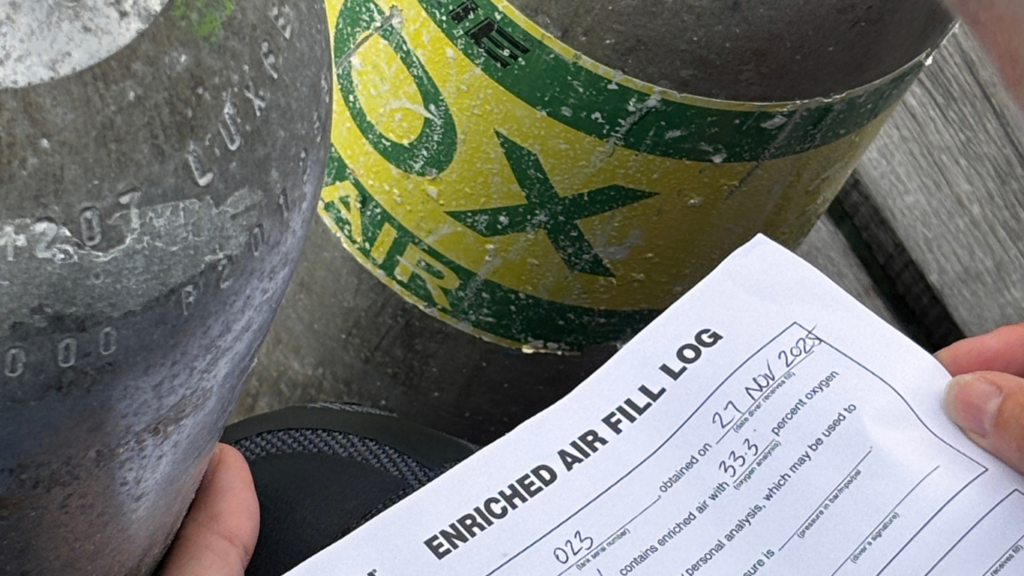
If you’ve ever walked into a dive center and noticed tanks with green and yellow markings, you’re not alone in wondering what they are. You might have heard other divers casually asking for them, talking about Nitrox diving as if it’s the obvious better option. But no one really stops to explain what it actually means, and that’s where confusion begins.
One of the most common ideas beginners pick up is that Nitrox diving gives you longer dives. It sounds logical, and it’s repeated often enough that many divers accept it as fact. The reality, however, is a bit more nuanced, and understanding that difference is what separates a confident diver from a confused one.
Nitrox simply refers to using a breathing gas that contains more oxygen and less nitrogen than regular air. Standard air is made up of about 21% oxygen, while Nitrox blends such as EANx32 and EANx36 increase that percentage to 32% or 36%. That change reduces the amount of nitrogen you inhale during a dive, which directly affects how your body absorbs gases underwater.
When you descend, nitrogen begins to dissolve into your tissues. This is what ultimately limits how long you can stay at a certain depth without needing decompression stops. By reducing nitrogen intake, Nitrox diving slows that process down. However, this is where many divers misunderstand its benefit. Nitrox diving does not automatically make your dives longer in terms of total time. Your actual dive duration still depends heavily on how deep you go and how quickly you consume your air.
What Nitrox diving really extends is your no-decompression limit, giving you more flexibility within safe boundaries rather than unlimited time underwater.
Within Nitrox diving, the most common blends are EANx32 and EANx36, and each serves a slightly different purpose. EANx32 is the most widely used because it offers a comfortable balance between extended no-decompression time and manageable depth limits. It’s often the preferred choice for recreational divers who want a practical advantage without significantly changing their dive planning.

EANx36, on the other hand, reduces nitrogen exposure even further, which can be beneficial in certain scenarios, particularly repetitive diving. However, the higher oxygen content introduces stricter depth limitations. As depth increases, so does the partial pressure of oxygen, and beyond a certain point, it can become unsafe. This is why Nitrox diving is not about going deeper but about optimizing time within shallower, controlled depth ranges.
One of the most important things to understand is that Nitrox does not guarantee longer dives. This misconception often leads to unrealistic expectations, especially among newer divers. The truth is that your total dive time is influenced more by your breathing rate and depth profile than by the gas mix itself.
What Nitrox diving does is extend your no-decompression limit, which becomes particularly useful during repetitive dives. For example, on a multi-dive day, your second and third dives are usually shorter because of residual nitrogen. With Nitrox diving, this limitation is reduced, allowing for more efficient dive profiles. However, if your air consumption is high, you will still end the dive based on your tank pressure, not your theoretical limit.
Nitrox is most beneficial in situations where you are doing multiple dives over a short period, such as on dive trips or liveaboards. It allows you to maintain better bottom times across consecutive dives and can make your overall diving experience more efficient and enjoyable.
However, there are environments where Nitrox diving is not the best option. A clear example is diving in Sipadan, where operations like Scuba Junkie do not allow its use. This decision is based on safety considerations, particularly the presence of down currents. In such conditions, divers can be pulled deeper than planned, and with Nitrox diving, exceeding depth limits increases the risk of oxygen toxicity. Using regular air in these environments provides a wider safety margin and reduces that risk.
The higher cost of Nitrox diving often raises questions, but it becomes easier to understand when you look at what’s involved. Producing Nitrox requires precise gas blending, specialized equipment, and strict safety protocols. Oxygen itself is more expensive than air, and tanks must be properly maintained to handle higher oxygen concentrations. Additionally, dive center staff need specific training to manage the process safely. All of these factors contribute to the increased price, reflecting the extra care and control required.
Nitrox is accessible to most certified divers and is particularly useful for those who dive frequently or travel for diving. Courses offered by organizations like PADI, SSI, and NAUI are usually straightforward and can often be completed in a short time. These courses focus on understanding oxygen exposure, analyzing gas mixes, and planning dives correctly.
For dive professionals, Nitrox diving becomes an additional tool that enhances both safety awareness and teaching capability. It’s not essential for every diver, but it is one of the most practical upgrades available in recreational diving.
Nitrox diving is safe when used correctly, but it requires awareness and discipline. While it reduces nitrogen exposure, it introduces oxygen limits that must always be respected. Divers need to analyze their tanks before each dive, confirm the oxygen percentage, and set their dive computers accordingly. The safety of Nitrox diving depends entirely on proper use, which is why training is essential.
Now that you have a clearer understanding of Nitrox diving, the decision becomes more personal. Does it sound like something that would improve your diving experience, or do you feel more comfortable staying with air, especially in environments where conditions can change quickly?
If you are already Nitrox certified, it’s worth reflecting on how you’ve been using it. Did you fully understand that it doesn’t necessarily extend your total dive time? Or has this explanation helped clarify that difference?
Sometimes, improving as a diver is not about learning something completely new, but about understanding familiar concepts more deeply.
1. What is Nitrox in simple terms?
Nitrox diving is scuba diving using a gas mix with more oxygen and less nitrogen than regular air.
2. Does Nitrox make dives longer?
No, it extends no-decompression limits, but total dive time still depends on depth and air consumption.
3. Is Nitrox allowed everywhere?
No, some locations like Sipadan do not allow it due to safety concerns.
4. Do I need certification for Nitrox?
Yes, a Nitrox course is required to use it safely.
5. Is Nitrox safer than air?
It can reduce nitrogen exposure, but it also introduces oxygen limits that must be managed carefully.
6. Why is Nitrox more expensive?
Because of the cost of oxygen, specialized equipment, and stricter safety procedures.
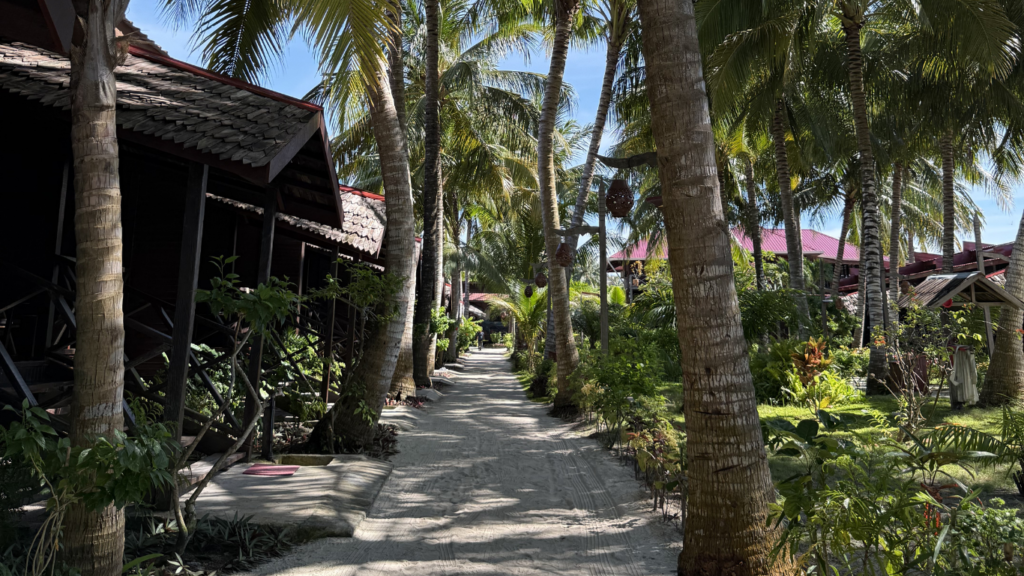
We know that when you go on holiday, all you really want is to relax.
But before that… there is always a bit of planning.
The good news is that getting to Scuba Junkie Sipadan is much simpler than it sounds. Our booking team takes care of almost everything. In reality, you just book your flights, and we help you with the rest.
Still, we know it helps to understand the journey. So here is a clear step-by-step guide you can come back to when you are ready to book.
The first step in getting to Scuba Junkie Sipadan is simply reaching out to us.
You can contact our booking team through:
Once you get in touch, we will send you all the information you need to choose the best package.
To help us guide you properly, include:
From there, we take care of the details with you.
Once your dates are confirmed, the next step in getting to Scuba Junkie Sipadan is booking your flight.
You will need to fly into Tawau Airport (Sabah, Malaysia).
From Tawau:
We can arrange your transfer, so your driver will be waiting for you at the airport with your name on a sign.
Important note:
After the airport transfer, you will arrive in Semporna, where our office is located.
At this stage of getting to Scuba Junkie Sipadan, you can choose to:
From Semporna, you will take a boat to Mabul Island.
Boat schedule:
The boat ride takes about one hour.
Planning this part properly makes getting to Scuba Junkie Sipadan smooth and stress-free.
This is important to keep you within safe diving limits.
If you need to stay overnight, there are several hotels within walking distance of our office:
This makes your travel day easy and stress-free.
On the day of your transfer, we will tag your luggage at check-in.
A few things to know:
This is all part of the experience of getting to Scuba Junkie Sipadan.
When you arrive at Mabul, our team will be there to welcome you and give you a full briefing about the resort and diving.
Once you arrive, everything slows down.
After arrival, you settle into your room, receive your welcome briefing, and start enjoying island life.
You will also receive a reusable water bottle to refill during your stay.
From here on, it is all about diving, relaxing, and enjoying the experience.
Contact the booking team, confirm your dates, and book your flight to Tawau.
Yes, airport transfers can be arranged but are paid directly to the driver.
Yes, if you plan to take the 8:00 AM boat.
Around one hour from Semporna to Mabul.
Only if you take the 8:00 AM transfer.
No. Once you understand the steps, it is very straightforward.
When you break it down, getting to Scuba Junkie Sipadan is simple.
Flight. Transfer. Boat. Arrival.
And once you are here, everything is taken care of.
If you have any questions, feel free to reach out or drop them in the comments. We are always happy to help.
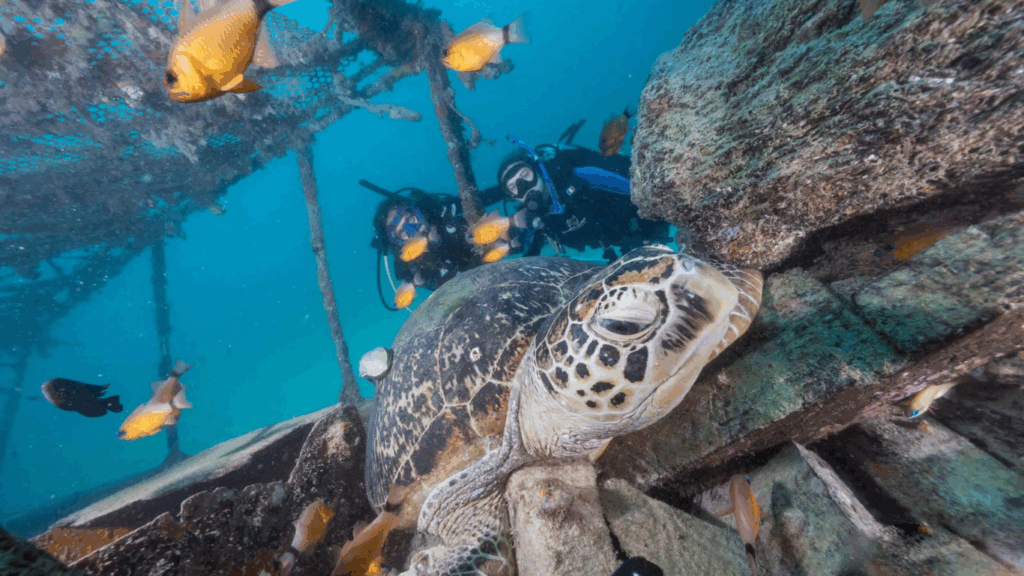
Always dreamed of breathing underwater? Want to explore coral reefs but have zero experience?
Then the Discover Scuba Diving Course (DSD) experience in Mabul Island is your ticket to a whole new world. Nestled in the heart of Borneo, Mabul is one of the best places in the world for beginner divers. Calm, shallow, and teeming with life, it offers the perfect conditions to fall in love with the ocean.
In this blog, we’ll walk you through everything you need to know about your first dive at Scuba Junkie Mabul—from safety to smiles, turtles to tips.
The DSD is a non-certification experience that gives beginners the chance to try diving in a safe, supervised environment. It’s not a license, but it is the first taste of what diving is all about.
At Scuba Junkie Mabul, your adventure starts with a friendly instructor guiding you through some basic theory and underwater skills—on land first, then in the water. There is no written exam, but you will complete a short final questionnaire to reinforce the key safety points.
You don’t need any previous experience. Just curiosity, comfort in the water, and a sense of adventure.
Here’s what a typical Discover Scuba Diving Course day with us looks like:
We start slow. You’ll learn how to breathe through your regulator, equalize your ears, clear your mask, and communicate with hand signals.
This isn’t a pool session—our confined water is in the calm, clear ocean, right off the beach. You’ll be surrounded by tropical fish as you learn. We use a dedicated training platform that allows you to practice safely without damaging the reef. You’ll master your buoyancy, breathing, and movement while already enjoying the marine life.
A full DSD day includes three dives. The first two are from shore, so you can get used to the gear and ocean environment. If your instructor sees you are comfortable and safe, the third dive will be from the boat, allowing you to explore even more.
Expect to see colorful corals, anemonefish, lionfish, and maybe even a turtle gliding past. Each dive is up to 12 meters deep and always guided.
Most divers surface beaming. It’s an unforgettable experience. And yes, you’ll want to go again.
We take your safety seriously. All our instructors are PADI certified, and group sizes are kept small so you get personal attention. Equipment is included and maintained to the highest standard.
You must complete a medical form before diving. Some health conditions may require a doctor’s approval.
Participants must be at least 10 years old.
If you’ve booked one of our Sipadan snorkeling packages, you can upgrade to a Discover Scuba Diving Course experience for free in Mabul (subject to medical conditions and availability).
It’s our way of giving you a taste of the diving world—and it might just change your life.
The full Discover Scuba Diving Course experience costs RM450 per person. This includes:
For many, this is the moment that starts a lifelong love affair with diving.
It’s paradise for your first bubbles.
Many divers who start with a Discover Scuba Diving Course experience go on to become certified. If you fall in love with the ocean (spoiler: you probably will), we offer both Open Water and Advanced Open Water courses right here in Mabul.
And yes, you can even dive Sipadan after certification!
Which part of your first dive are you most excited for? Tell us in the comments
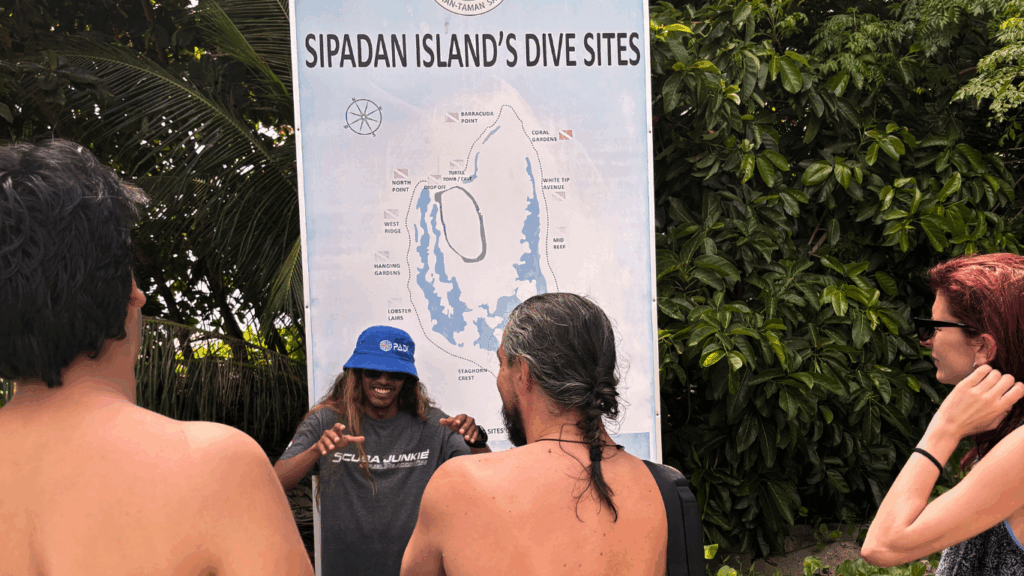
Ready to embark into your Dive Pro Journey, thinking about becoming a dive professional but overwhelmed by all the info online? You’re not alone.
If you’re here, you’re probably already dreaming about swapping your 9-to-5 for a life underwater—surrounded by coral reefs, friendly turtles, and the kind of community that turns coworkers into lifelong dive buddies.
Welcome to the dive pro journey you’ve been searching for. We’re here to walk you through what it really means to become a PADI Divemaster or Instructor with Scuba Junkie Mabul—and why it just might change your life.
Being a dive pro is more than guiding dives or checking equipment—it’s about becoming a role model, teacher, conservationist, and storyteller.
As a PADI Divemaster or Instructor, your days will be filled with:
It’s meaningful work. It’s lifestyle-changing. And it all starts here.
At Scuba Junkie Mabul, we offer both the Divemaster Course (DMC) and the Instructor Development Course (IDC). Here’s what your Dive Pro Journey include:
It’s full-on, but in the best way.
Here’s what you’ll need for each step of the dive pro journey:
Need help preparing? We can advise on every step.
📢 Book early—space is limited and spots fill months in advance.
Mark your calendar and get ready to change your life:
Want to arrive early and warm up your skills? Add a few fun dives or a refresher week before your course!
We’re not just a dive center. We’re a mission.
At Scuba Junkie Mabul, your dive pro journey is about more than a card—it’s about mentorship, sustainability, and joining a global family of divers who care.
From our eco-friendly resort to our conservation work with SEAS, everything we do is shaped by love for the ocean—and for the people who dive into it.
And yeah… diving with turtles before breakfast isn’t bad either 🐢
You’ve felt the pull. The what if. The dream of waking up on a tropical island and calling the ocean your office.
This is your sign. Your chance. Your dive pro journey starts here.
Got questions? Drop them in the comments!
Want to sign up? Message us or visit the Scuba Junkie Pro Courses page to learn more.
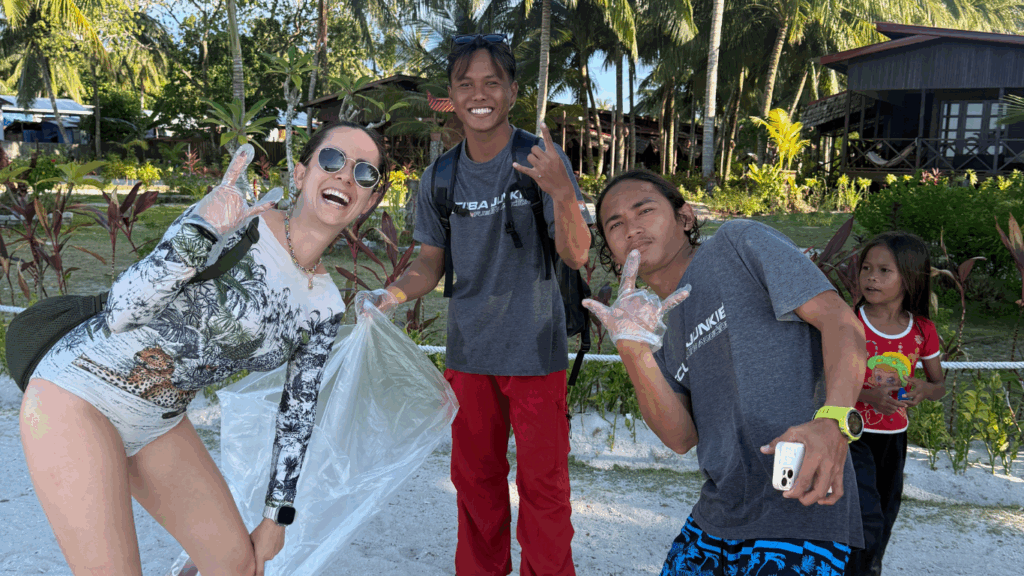
🌊 APPLICATIONS ARE NOW CLOSED 🌊
Thank you for your incredible support!
We were truly overwhelmed (in the best way) by the number of passionate marine biologists who applied for the recent position at Scuba Junkie SEAS. Your enthusiasm and commitment to ocean conservation exceeded all our expectations!
We’d also like to sincerely apologise for any delays in responding to emails — between our daily conservation efforts and the amazing wave of applications, our inbox was overflowing. 💙
Although the applications are closed, we invite you to explore what Scuba Junkie SEAS is all about and how you can still be part of the change. Here’s why we’re one of the most impactful marine conservation NGOs in Malaysia.
Scuba Junkie SEAS is the registered non-profit arm of Scuba Junkie, committed to safeguarding marine life around Mabul Island, Malaysia. As a prominent marine conservation NGO in Malaysia, we combine science, education, and grassroots action to create lasting change in ocean health.
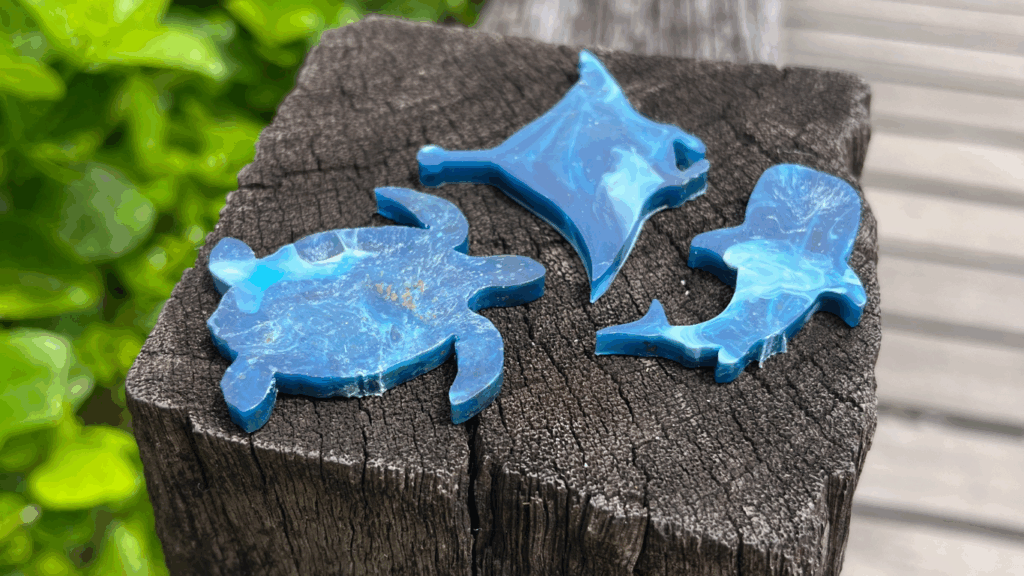
We collect essential data from Sipadan and Si Amil islands, focusing on sharks, rays, and reef health. This contributes to global marine biodiversity records and informs our conservation strategies.
Our projects involve collaboration with trusted global organisations like WWF Malaysia and the Marine Megafauna Foundation (MMF) in Sangalaki.
While our application round has closed, you can still support our mission:
We may not be hiring today, but we’re always growing the global ocean family. Follow us for future updates and help us keep the reef alive. 💙
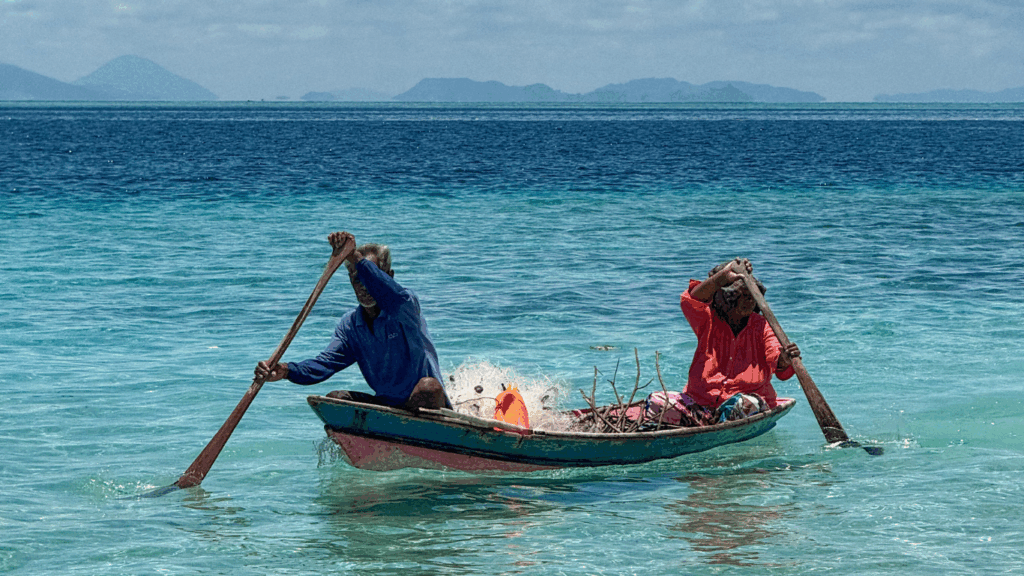
Tucked away just a 45-minute boat ride from Mabul Island, Si Amil feels like a secret only the ocean knows. If you’ve been diving around Mabul or dreaming of Sipadan, here’s a golden detour that feels like a holiday within a holiday—calm turquoise waters, white sandy beaches, and an island you might just have all to yourself. Exploring Si Amil isn’t just about the diving—it’s about the experience, the feeling of discovery, and reconnecting with nature in a way few places allow.
It begins early—breakfast at the resort as the sun rises over the Celebes Sea, then it’s time to hop on the boat and head off. The ride is peaceful, usually under an hour, but it feels like you’re heading somewhere truly special. Most days, there’s no one else around. No crowds. No noise. Just you, the crew, and the vast blue ahead. This is exploring Si Amil.
Once you arrive, you’ll gear up and jump into dive number one—but not before the all-important dive briefing, of course.
Our first dive of the day usually heads into the blue—literally. With few corals around, it’s what we call a “blue dive.” But don’t let that fool you. We’re heading for a cleaning station, an underwater spa where devil rays gather to be cleaned by smaller reef fish.
It’s the anticipation that gets you—hovering over the deep, watching and waiting. Sometimes they glide in by the dozens, and you’ll feel your heart race as these elegant creatures circle with impossible grace. And when they do show up, it’s nothing short of magical.
The second dive brings you closer to the island, to a vibrant reef that’s shallow, colorful, and absolutely bursting with life. You don’t even need to go deep—just drift along the top and let the reef amaze you. The coral here is healthy and untouched, and if you’re into macro life, this is where you’ll spot frogfish, ghost pipefish, nudibranchs, and maybe even a rhinopia if you’re lucky.
It’s like swimming through a garden. Time slows down. The only sound is your bubbles.
After the first dive, we head to shore for “second breakfast”—and this is where Si Amil really shows off. Imagine this: white sand under your feet, lush jungle behind you, and turquoise waters stretching endlessly into the horizon. Sometimes monkeys come to greet you, swinging lazily from tree to tree. You sip your coffee, toes in the sand, phone forgotten. This is pure disconnect.
And it’s all yours for the day.
Just a heads-up: there are no toilet facilities on the island, so it’s best to plan accordingly before departure. It’s part of the remote charm—but worth knowing in advance!
After dive two, we’re back on the island. A hearty lunch awaits, and the vibe is as chilled as it gets. Divers lounging under the trees, some taking photos, others catching a nap. It’s the perfect recharge before dive number three.

The third dive brings the day to a close. Another reef dive, perhaps “First Beach” or “Meditation Wall,” where everything from ribbon eels to electric clams might make an appearance. This dive often surprises us the most—nature has a way of saving the best for last.
Si Amil invites you to slow down and tune in—not by cutting off your signal, but by offering something better: a genuine connection with nature. Whether you’re watching monkeys play in the trees, lounging on the powdery beach between dives, or floating in crystal-clear shallows, your body relaxes and your mind clears. It’s not about going offline—it’s about going outside. Si Amil gives you the space to breathe, unwind, and remember what true peace feels like.
So, is exploring Si Amil worth it? We get this question all the time—and the answer is a definite yes, whenever time and budget allow. It’s more than just another dive day; it’s a full-on experience. A tropical escape, pristine reefs, the possibility of devil rays, and that magical surface interval on the beach—it all adds up to something unforgettable.
At Scuba Junkie, we offer Si Amil exclusively as part of our 4D3N dive package, which includes:
It’s the perfect way to combine world-class pelagics with beautiful reefs and incredible macro life—all while staying at our eco-friendly Mabul Beach Resort.
If you’re dreaming of diving Sipadan in 2025, there’s one golden rule to remember: you must be a certified Advanced Open Water diver to access this legendary dive site. But don’t worry—whether you’re a total beginner or already planning your next course, Scuba Junkie offers the perfect training paths to help you dive Sipadan safely and confidently.
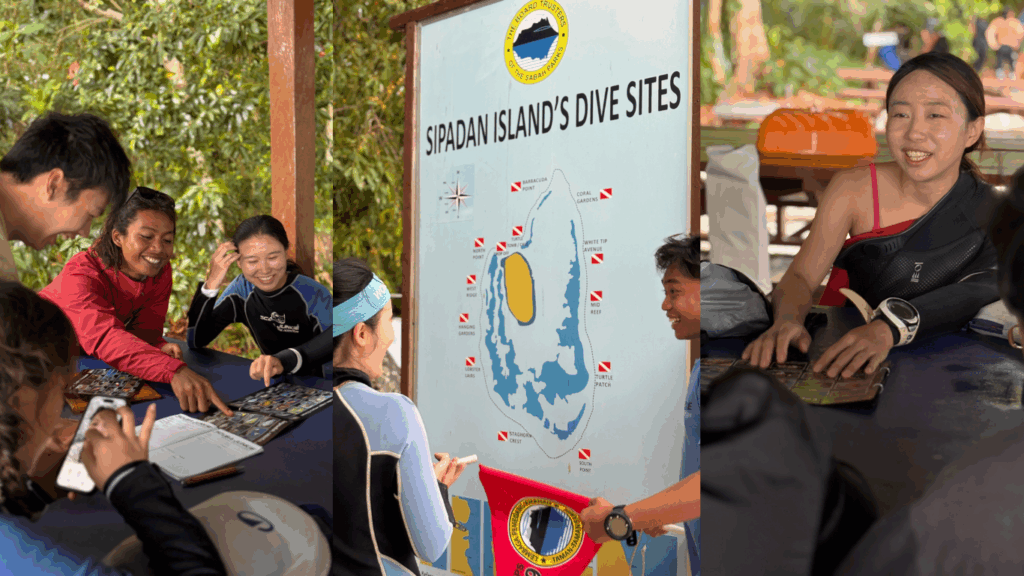
Located off Borneo’s coast, Sipadan is one of the most iconic dive sites in the world—home to massive schools of jackfish, turtles galore, white-tip reef sharks, and stunning vertical walls covered in coral.
With limited daily permits and strict protection rules, diving here is a rare and privileged experience. It’s the kind of place divers dream about—and with the right guidance, you can make it happen in 2025.
This is the ultimate path for those who start from zero but want to end their trip diving one of the best sites in the world. You’ll begin with the Open Water course, followed by the Advanced Open Water course, then finish with your first dives as a fully certified Advanced diver at Sipadan—a true celebration dive!
✅ Includes:
🎉 Many divers describe their first Sipadan dives as the perfect way to celebrate completing their certifications!
If you’re already a certified Open Water diver, you’re just one step away from diving Sipadan. Scuba Junkie’s Advanced Open Water + Sipadan dive package lets you complete the course with our experienced instructors, then head straight into the deep blue of Sipadan.
🔹 The AOW course:
🌊 While Sipadan can have currents, our team ensures the experience is safe and smooth for divers with little experience. You’ll always be guided in small groups by professionals who know the site inside out.
While diving at Sipadan is restricted to Advanced divers, snorkelers are welcome too, and the experience is spectacular. Shallow reefs teeming with life make this a must-do, even for non-divers. You may spot:
🦺 Please note that life jackets are mandatory for snorkelers and freediving is not allowed under Sabah Parks regulations.
🌊 Whether you’re starting from zero or upgrading your skills, we’ll help you reach Sipadan confidently, safely—and smiling.
Booking your journey now means securing your spot and starting your path toward one of the most incredible diving experiences on Earth.
📌 Learn more:
Have questions? Our team is just an email away at sipadan@scubajunkie.com.