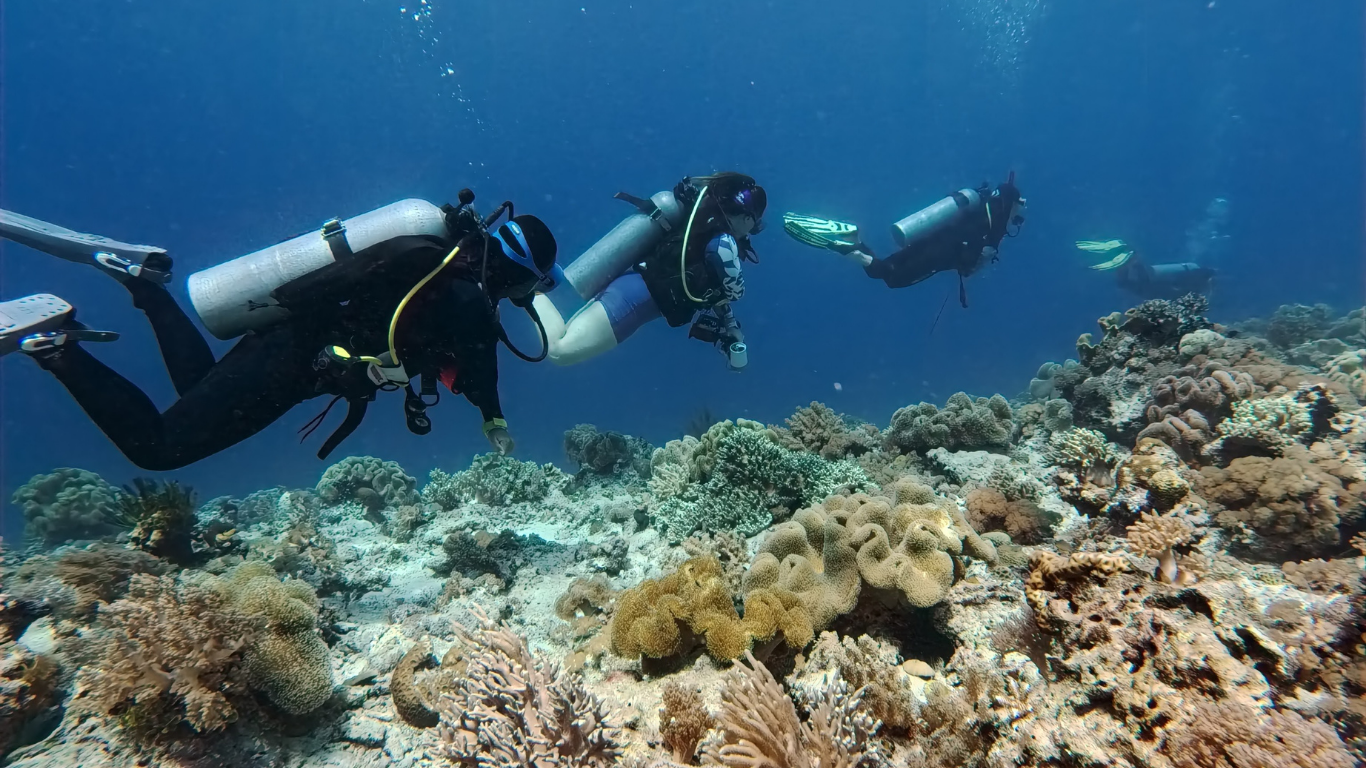
We provide daily dive trips and dive courses around Mabul, Sipadan and Semporna area.
Looking for tips and tricks about diving, marine life or what to do in Borneo? Follow us on our blog for weekly updates from the team!




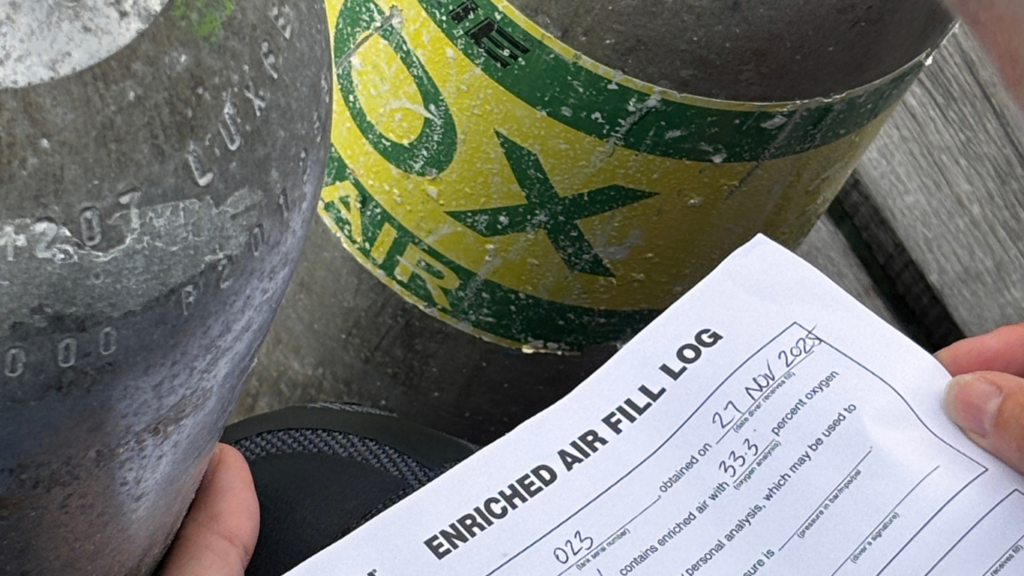
If you’ve ever walked into a dive center and noticed tanks with green and yellow markings, you’re not alone in wondering what they are. You might have heard other divers casually asking for them, talking about Nitrox diving as if it’s the obvious better option. But no one really stops to explain what it actually means, and that’s where confusion begins.
One of the most common ideas beginners pick up is that Nitrox diving gives you longer dives. It sounds logical, and it’s repeated often enough that many divers accept it as fact. The reality, however, is a bit more nuanced, and understanding that difference is what separates a confident diver from a confused one.
Nitrox simply refers to using a breathing gas that contains more oxygen and less nitrogen than regular air. Standard air is made up of about 21% oxygen, while Nitrox blends such as EANx32 and EANx36 increase that percentage to 32% or 36%. That change reduces the amount of nitrogen you inhale during a dive, which directly affects how your body absorbs gases underwater.
When you descend, nitrogen begins to dissolve into your tissues. This is what ultimately limits how long you can stay at a certain depth without needing decompression stops. By reducing nitrogen intake, Nitrox diving slows that process down. However, this is where many divers misunderstand its benefit. Nitrox diving does not automatically make your dives longer in terms of total time. Your actual dive duration still depends heavily on how deep you go and how quickly you consume your air.
What Nitrox diving really extends is your no-decompression limit, giving you more flexibility within safe boundaries rather than unlimited time underwater.
Within Nitrox diving, the most common blends are EANx32 and EANx36, and each serves a slightly different purpose. EANx32 is the most widely used because it offers a comfortable balance between extended no-decompression time and manageable depth limits. It’s often the preferred choice for recreational divers who want a practical advantage without significantly changing their dive planning.

EANx36, on the other hand, reduces nitrogen exposure even further, which can be beneficial in certain scenarios, particularly repetitive diving. However, the higher oxygen content introduces stricter depth limitations. As depth increases, so does the partial pressure of oxygen, and beyond a certain point, it can become unsafe. This is why Nitrox diving is not about going deeper but about optimizing time within shallower, controlled depth ranges.
One of the most important things to understand is that Nitrox does not guarantee longer dives. This misconception often leads to unrealistic expectations, especially among newer divers. The truth is that your total dive time is influenced more by your breathing rate and depth profile than by the gas mix itself.
What Nitrox diving does is extend your no-decompression limit, which becomes particularly useful during repetitive dives. For example, on a multi-dive day, your second and third dives are usually shorter because of residual nitrogen. With Nitrox diving, this limitation is reduced, allowing for more efficient dive profiles. However, if your air consumption is high, you will still end the dive based on your tank pressure, not your theoretical limit.
Nitrox is most beneficial in situations where you are doing multiple dives over a short period, such as on dive trips or liveaboards. It allows you to maintain better bottom times across consecutive dives and can make your overall diving experience more efficient and enjoyable.
However, there are environments where Nitrox diving is not the best option. A clear example is diving in Sipadan, where operations like Scuba Junkie do not allow its use. This decision is based on safety considerations, particularly the presence of down currents. In such conditions, divers can be pulled deeper than planned, and with Nitrox diving, exceeding depth limits increases the risk of oxygen toxicity. Using regular air in these environments provides a wider safety margin and reduces that risk.
The higher cost of Nitrox diving often raises questions, but it becomes easier to understand when you look at what’s involved. Producing Nitrox requires precise gas blending, specialized equipment, and strict safety protocols. Oxygen itself is more expensive than air, and tanks must be properly maintained to handle higher oxygen concentrations. Additionally, dive center staff need specific training to manage the process safely. All of these factors contribute to the increased price, reflecting the extra care and control required.
Nitrox is accessible to most certified divers and is particularly useful for those who dive frequently or travel for diving. Courses offered by organizations like PADI, SSI, and NAUI are usually straightforward and can often be completed in a short time. These courses focus on understanding oxygen exposure, analyzing gas mixes, and planning dives correctly.
For dive professionals, Nitrox diving becomes an additional tool that enhances both safety awareness and teaching capability. It’s not essential for every diver, but it is one of the most practical upgrades available in recreational diving.
Nitrox diving is safe when used correctly, but it requires awareness and discipline. While it reduces nitrogen exposure, it introduces oxygen limits that must always be respected. Divers need to analyze their tanks before each dive, confirm the oxygen percentage, and set their dive computers accordingly. The safety of Nitrox diving depends entirely on proper use, which is why training is essential.
Now that you have a clearer understanding of Nitrox diving, the decision becomes more personal. Does it sound like something that would improve your diving experience, or do you feel more comfortable staying with air, especially in environments where conditions can change quickly?
If you are already Nitrox certified, it’s worth reflecting on how you’ve been using it. Did you fully understand that it doesn’t necessarily extend your total dive time? Or has this explanation helped clarify that difference?
Sometimes, improving as a diver is not about learning something completely new, but about understanding familiar concepts more deeply.
1. What is Nitrox in simple terms?
Nitrox diving is scuba diving using a gas mix with more oxygen and less nitrogen than regular air.
2. Does Nitrox make dives longer?
No, it extends no-decompression limits, but total dive time still depends on depth and air consumption.
3. Is Nitrox allowed everywhere?
No, some locations like Sipadan do not allow it due to safety concerns.
4. Do I need certification for Nitrox?
Yes, a Nitrox course is required to use it safely.
5. Is Nitrox safer than air?
It can reduce nitrogen exposure, but it also introduces oxygen limits that must be managed carefully.
6. Why is Nitrox more expensive?
Because of the cost of oxygen, specialized equipment, and stricter safety procedures.