


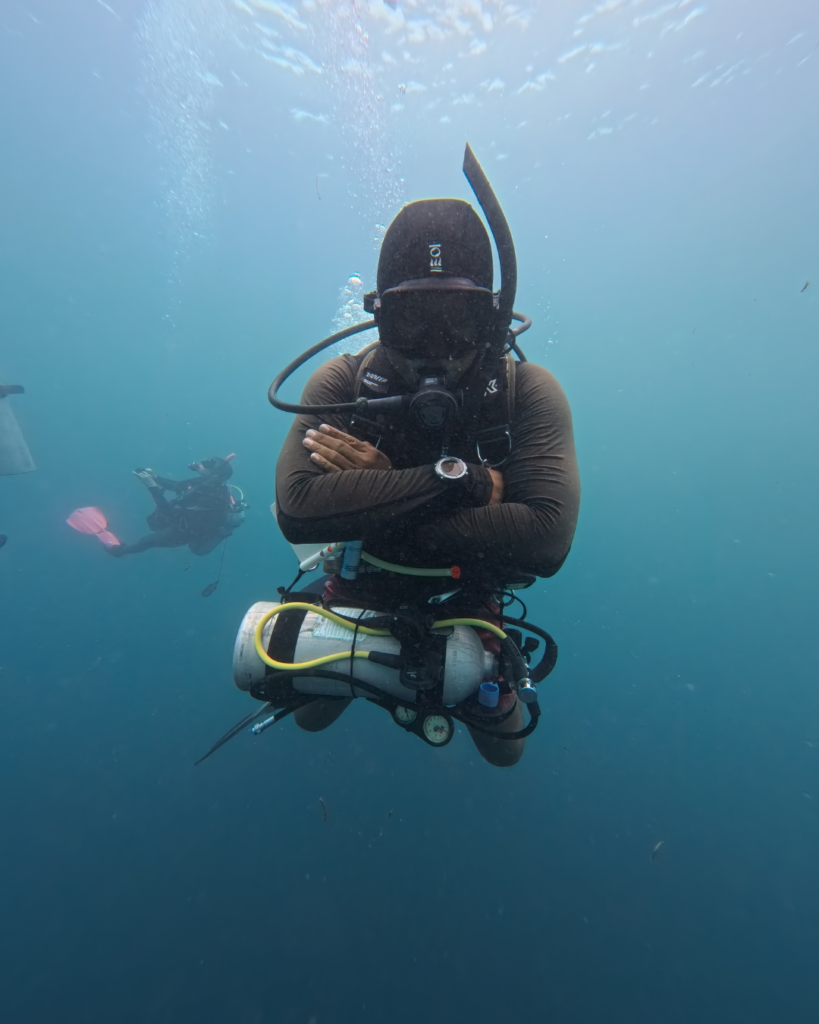
You’re at 35 metres. The visibility is great, you’re comfortable, and everything feels strangely… amazing.
Maybe too amazing.
Your buddy gives you a signal and, for some reason, it takes you a few seconds longer than usual to understand it. You check your pressure gauge, look away, and immediately forget what number you just saw. Or perhaps you feel incredibly confident, relaxed and convinced that everything is completely under control.
Welcome to one of the strangest effects of deep diving.
Gas narcosis explained simply is this: as we descend and breathe compressed gas at increasing pressure, certain gases can temporarily affect the way our brain works. Judgment, concentration, coordination and reaction time can all change, sometimes without the diver realizing it is happening.
Divers often call this being “narced.” You may also have heard names such as nitrogen narcosis, depth intoxication or rapture of the deep.
It can sound funny, and sometimes it certainly feels funny. But when your ability to make decisions underwater is affected, it deserves to be taken seriously.
Gas narcosis is a temporary, reversible change in brain function caused by breathing gases under increased pressure. For recreational divers breathing compressed air, nitrogen is the main gas associated with narcosis.
As you descend, the surrounding pressure increases. The partial pressure of the nitrogen you breathe increases with it, producing a greater narcotic effect on the central nervous system. Researchers still do not completely understand the exact mechanism, but the effect on cognition and behaviour is well established.
The deeper you go, the stronger the potential effect becomes.
Meaningful impairment can occur around 30 metres, although there is no magic depth at which every diver suddenly becomes narced. One person may notice obvious effects while another feels completely normal at the same depth. Even more importantly, the same diver can react differently from one dive to another.
That unpredictability is part of what makes narcosis interesting and potentially dangerous.
Air is roughly 78% nitrogen. At the surface, breathing it obviously does not make us narced.
Underwater, however, pressure changes everything.
At 10 metres, the surrounding absolute pressure is approximately twice what it is at the surface. At 20 metres it is approximately three times, at 30 metres four times, and at 40 metres five times.
As total pressure increases, so does the partial pressure of the nitrogen in the breathing gas. At sufficient pressure, inert gases can interfere with normal nervous-system function and produce an anaesthetic-like effect.
What does that mean in English?
Imagine having a couple of drinks at a party. You might feel relaxed and confident. You may think you’re being extremely funny. Your friends might have a slightly different opinion.
More importantly, you may not realize that your reactions and judgment have slowed.
Narcosis can be similar in one important respect: the person affected may not recognize how impaired they are.
This is why the old diving idea of comparing narcosis to having a martini for every additional 10 metres of depth is memorable, but shouldn’t be taken literally. Narcosis varies too much between people and between dives for that to be a reliable rule.
This is where things get interesting, because being narced does not feel the same for everyone.
One diver might experience euphoria and think the dive is absolutely fantastic. Another might become anxious or uncomfortable. Someone else might struggle with a simple task that would normally take seconds.
Common effects include reduced concentration, slower reasoning, impaired judgment, memory problems, overconfidence, euphoria, anxiety and reduced manual coordination.
Imagine your guide asks you to read your gauge and signal your remaining gas. Normally, this takes seconds. At depth, you look at the gauge. You know what it says. You know the signal.
But somehow connecting those two pieces of information suddenly requires much more concentration.
That is the real concern with narcosis. It does not need to make you completely confused to become relevant. A small reduction in judgment or reaction time can matter when you’re deep underwater.
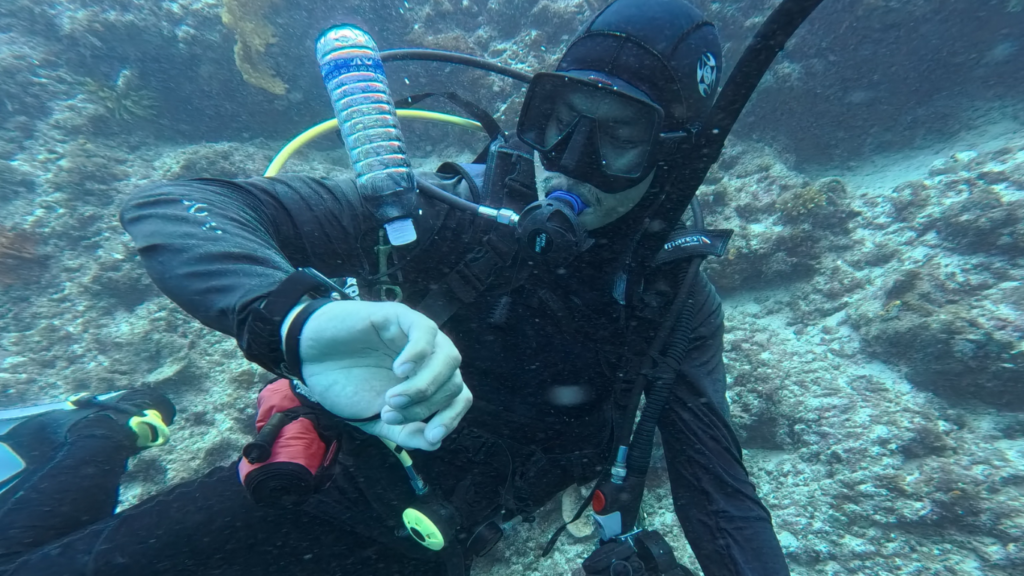
One of the biggest mistakes divers can make is thinking, “I’ve been to 35 metres before and I was fine, so narcosis doesn’t affect me.”
It does not work like that.
Susceptibility varies between divers and can even vary in the same diver from day to day. Fatigue, anxiety, alcohol, cold and increased carbon dioxide levels associated with exertion can worsen impairment.
Imagine doing the same deep dive twice. On the first dive you’re rested, relaxed and swimming gently in perfect conditions. On the second you’re tired, fighting current and breathing heavily.
The number on your depth gauge may be identical.
Your experience may not be.
This is another reason good deep-diving decisions should be based on how you feel today, not simply on what you have successfully done before.
Narcosis itself is generally reversible and does not usually cause direct injury. The danger comes from what you might do while your judgment is impaired.
A narced diver might forget to monitor gas, descend deeper without noticing, respond poorly to a problem, become separated from a buddy, make an inappropriate ascent or struggle with a task that would normally be easy.
This is why “I actually enjoy being narced” is not quite the flex it might sound like.
Feeling euphoric is one possible effect. Overconfidence is another.
And underwater, those two can be a dangerous combination.
The solution to gas narcosis is surprisingly simple: reduce the depth.
As you ascend to a shallower depth, the partial pressure of the narcotic gas decreases and symptoms normally improve rapidly.
This is why recognizing narcosis in yourself and your buddy matters. If something suddenly feels wrong at depth, if a simple task becomes strangely difficult, or if your buddy starts behaving unusually, depth should be part of what you consider.
You do not prove anything by staying deep and trying to “fight” narcosis.
A controlled ascent to a shallower depth is the appropriate response. If symptoms do not resolve normally after becoming shallower, the dive should be ended and the situation treated seriously, because other diving-related conditions can produce neurological symptoms.
You cannot train yourself to become immune to pressure, but you can reduce your exposure and make better decisions around it.
The simplest tool is depth. Shallower depth means lower partial pressure and therefore less narcotic effect. Being rested, avoiding alcohol before diving, staying warm, managing anxiety and avoiding unnecessary exertion also remove factors associated with greater impairment.
Training matters too, but perhaps not for the reason people think.
Deep-diving training does not magically stop you from getting narced. It teaches you to plan deep dives properly, recognize changes in yourself and others, manage gas and depth, and respond appropriately when something does not feel right.
Experience can make you more familiar with the environment. It does not make the laws of physics disappear.
This distinction is important.
Gas narcosis happens at depth because of the increased partial pressure of narcotic gases. Symptoms generally improve quickly when the diver ascends to a shallower depth.
Decompression sickness is different. It involves inert gas coming out of solution and forming problematic bubbles in the body during or after pressure reduction. Symptoms can occur after ascent and require medical assessment and potentially hyperbaric treatment.
In simple terms, narcosis is about what increased gas pressure is doing to your brain while you are deep. Decompression sickness is about what can happen as dissolved inert gas leaves your tissues during and after ascent.
They both involve diving and inert gases, but they are not the same problem.

Deep diving can be incredible. Walls disappear beneath you, certain wrecks become accessible, and the experience itself can challenge you to become a more thoughtful diver.
But deeper does not automatically mean better.
Understanding gas narcosis explained through both the science and the real-life experience helps us understand why deep diving requires additional awareness. Narcosis can be funny in a meme. Underwater, impaired judgment deserves respect.
Know your limits, pay attention to your buddy, stay aware of how you feel, and remember that becoming shallower is always an option.
And now we want to hear from you.
Have you ever been narced? What did it feel like, and when did you realize it was happening?
There is no exact depth that affects every diver equally. Cognitive impairment can become noticeable around 30 metres, but individual responses vary significantly and effects generally become stronger as depth increases.
The terms are often used interchangeably in recreational diving because nitrogen is the main narcotic gas in compressed air. Gas narcosis is the broader and more accurate term because other gases can also have narcotic properties.
No. Experience may help a diver recognize and manage the effects, but it does not make someone immune. A diver’s response can also vary between dives.
The primary response is to ascend in a controlled manner to a shallower depth. The symptoms usually improve rapidly as ambient pressure and the partial pressure of the narcotic gas decrease.
Yes. Euphoria and overconfidence are possible effects, but narcosis can also cause anxiety, impaired concentration, poor judgment and slower reactions. Not everyone experiences it in the same way.
No. Gas narcosis occurs at depth because of increased gas partial pressures and normally improves after ascending shallower. Decompression sickness has a different mechanism involving inert gas coming out of solution during or after pressure reduction and requires appropriate medical assessment.
You’re diving along a beautiful reef. Visibility is amazing, the current is gentle, and then suddenly a shark appears out of the blue. Everybody stops to admire it. You’re completely focused on the encounter when your dive computer starts making noises you’ve never heard before.
Beep. Beep. Beep.
You look down at the screen and something is flashing. Unsure what it means, you swim over to your guide and show him the computer. He takes a quick look, gives you an OK sign, and starts leading the group slightly shallower.
A minute later, the alarm stops.
Back on the boat, you ask your guide what all the beeping was about.
“You were getting close to your no decompression limit,” he says.
You vaguely remember hearing about it during your Open Water course. Maybe it came up again during Advanced Open Water. But if you’re like most recreational divers who only dive once or twice a year, the details are probably a little fuzzy.
So let’s start from the beginning.
A no decompression limit is the maximum amount of time you can spend at a certain depth and still be able to make a normal ascent directly to the surface.
This is where many divers get confused because they mix up safety stops and decompression stops.
A safety stop is the three-minute stop most recreational divers make at around 5 meters before surfacing. It is recommended because it adds an extra margin of safety and helps your body release nitrogen more gradually.
A decompression stop is completely different.
A decompression stop is mandatory. It means your body has absorbed enough nitrogen that you cannot safely ascend directly to the surface anymore. You must stop at specific depths for specific amounts of time to allow your body to release that excess nitrogen safely.
As recreational divers, we plan our dives so we stay within the no decompression limit and avoid mandatory decompression stops altogether.
Before we make this simple, let’s understand what is actually happening inside your body.
As you descend underwater, pressure increases. At the surface, you are under one atmosphere of pressure. At 10 meters, you are under two atmospheres. At 20 meters, three atmospheres. At 30 meters, four atmospheres.

Surface (0m) = 1 ATA 🎈
10m = 2 ATA 🎈🎈
20m = 3 ATA 🎈🎈🎈
30m = 4 ATA 🎈🎈🎈🎈
40m = 5 ATA 🎈🎈🎈🎈🎈
The balloons represent the increasing amount of nitrogen being pushed into the body’s tissues as pressure increases.
As the pressure around you increases, more nitrogen from the air you breathe dissolves into your blood and tissues. Nitrogen itself is not dangerous. In fact, about 78% of the air we breathe is nitrogen.
The issue is that the deeper you go and the longer you stay there, the more nitrogen your body absorbs. Your dive computer continuously calculates this process and estimates how much nitrogen is accumulating in your tissues.
The no decompression limit is essentially your computer’s way of saying:
“You still have enough time to ascend normally.”
Once you get too close to that limit, your computer starts paying attention. If you exceed it, the computer will ask you to make decompression stops before surfacing.
Let’s forget the science for a moment.
Imagine opening a bottle of soda. While the bottle is sealed, the pressure keeps the gas dissolved in the liquid. Open it too quickly and bubbles appear everywhere.
Your body behaves in a similar way. At depth, pressure keeps nitrogen dissolved inside your tissues. As you ascend, the pressure decreases and that nitrogen needs to leave your body gradually.
Here’s another example that divers often find easier to visualize.
Imagine a sponge sitting under a running tap. The longer it stays under the water, the more it absorbs. Your body works in a similar way with nitrogen. A shallow dive is like a sponge that gets slightly wet. A deeper and longer dive is like a sponge that becomes completely saturated.
When you ascend, your body needs time to “squeeze out” that nitrogen safely. The more nitrogen you’ve absorbed, the more careful you need to be.
The no decompression limit exists to make sure you never absorb so much nitrogen that special decompression stops become necessary.
One of the main goals of recreational diving is simplicity.
If something unexpected happens underwater, recreational divers should be able to begin a controlled ascent and safely reach the surface without additional decompression obligations.
Technical divers are different.
They intentionally conduct decompression dives, but they also receive specialized training, carry additional gas supplies, use redundant equipment, and plan their dives in much greater detail.
A recreational diver who accidentally exceeds the no decompression limit may suddenly find themselves in a situation they were never trained to manage.
That is why staying within your NDL is such a fundamental part of recreational dive planning.
Imagine you’re on the fourth day of a dive trip. The visibility is incredible, the reef is full of life, and before you know it, you’ve spent longer at depth than you intended.
Suddenly your computer displays a decompression obligation.
At first glance, it may not seem like a big deal. After all, it’s only a few minutes.
But now imagine your air supply is already lower than expected. Perhaps there is a current. Maybe your buddy is also getting low on gas.
That decompression stop is no longer just a number on a screen. It becomes a critical part of the dive.
This is one of the reasons recreational divers are taught to avoid entering decompression. It’s not only about nitrogen. It’s about maintaining options and having enough margin to deal with the unexpected.
One thing many new divers notice is that experienced divers often seem more conservative than beginners expect.
They don’t stay at the deepest part of the dive until the last possible minute. They don’t race their NDL countdown. They don’t treat their dive computer like a challenge to beat.
Instead, they leave themselves room for error.
They know that fatigue, dehydration, repetitive dives, currents, and even individual physiology can influence how the body handles nitrogen.
Their goal is not to squeeze every possible minute out of a dive.
Their goal is to enjoy thousands of dives over many years.
The next time your computer starts beeping while you’re admiring a shark, you’ll know it isn’t trying to ruin the moment.
It’s simply reminding you that your body has limits.
The no decompression limit is one of the most important safety tools in recreational diving. It helps divers manage nitrogen absorption, stay within their training, and maintain enough flexibility to deal with unexpected situations.
The more you understand what your dive computer is telling you, the better decisions you can make underwater.
And better decisions lead to safer, more enjoyable dives.
Have you ever had your dive computer start beeping unexpectedly underwater? Let us know what happened in the comments.
A no decompression limit is the maximum amount of time a diver can stay at a certain depth and still ascend directly to the surface without mandatory decompression stops.
No. A safety stop is recommended and adds an extra margin of safety. A decompression stop is mandatory when a diver has absorbed too much nitrogen to ascend directly to the surface.
Recreational diving is planned around staying within no decompression limits. Intentional decompression diving requires additional training and falls under technical diving.
The deeper you go, the more pressure you are under and the faster your body absorbs nitrogen.
The risk is very low, but no dive is completely risk-free. Factors such as hydration, fatigue, repetitive diving, and individual physiology can influence risk.
The warning gives you time to adjust your depth or begin ascending before you enter decompression obligations.

You’re on the boat, your gear is ready, and everyone is eager to jump in. It’s exciting, especially when you’re about to dive somewhere you’ve been dreaming about for months.
Then your guide stands up and starts the dive briefing.
For some divers, that’s the moment to pay attention. For others, it’s the perfect time to adjust a mask, chat with a buddy, or take one last look at the ocean.
We’ve all seen it.
But here’s the thing: the dive has already started.
Every experienced diver knows the saying, “Plan your dive. Dive your plan.“ That plan begins with the dive briefing. It’s the moment where everyone on the boat shares the same information, understands the same plan, and knows what to expect once they descend.
A good dive briefing isn’t there to delay the fun. It helps make sure the fun lasts for the entire dive.
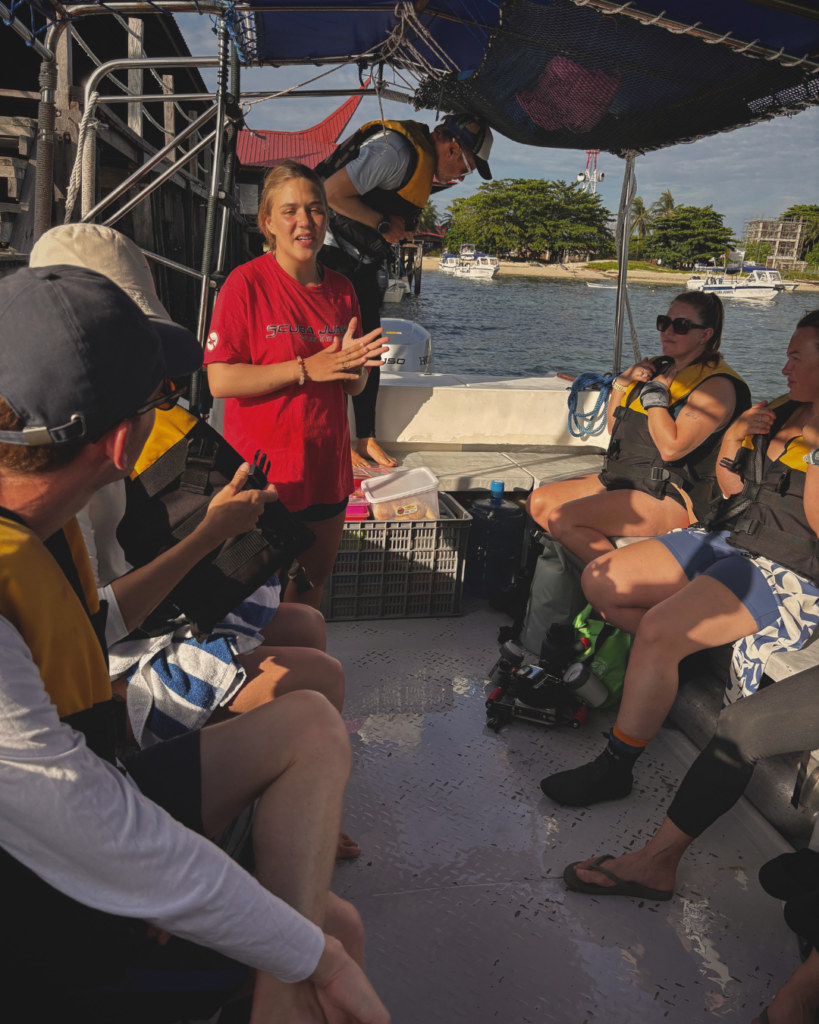
One of the biggest misconceptions in diving is that if you’ve dived a site before, you already know it.
The truth is, no two dives are ever the same.
The current changes. Visibility changes. Marine life moves. Even the people you’re diving with make each dive different.
A dive briefing isn’t there because guides enjoy talking. Well… some of them probably do, but that’s not really the point.
The point is to make sure everyone enters the water with the same understanding of the dive ahead. The more you know before the dive, the more you can relax and enjoy it once you’re underwater.
Every briefing should start by introducing the dive site.
Whether it’s your first visit or your fiftieth, knowing where you are helps put everything else into context. It also gives your guide the chance to explain what makes that particular site special and what you can expect to see.
This is where the guide paints a picture of the dive.
Will you be following a reef wall? Swimming over a sandy bottom? Drifting with the current? Is there a section of the reef where turtles usually rest or where schools of fish often gather?
The more you can visualise the dive before entering the water, the easier it is to relax once you’re underwater.
It sounds simple, but it’s important.
Who will be leading the group? Where should divers position themselves? Is there someone bringing up the rear?
Knowing who to follow avoids confusion once the dive begins.
Every dive site is different.
Some dives begin with a giant stride, others with a back roll or a shore entry. The exit can also vary depending on sea conditions or the boat you’re diving from.
Knowing exactly how you’ll enter and leave the water helps everyone feel more confident.
This is where the famous saying comes to life.
Your guide should explain the planned route, the maximum depth, the expected dive time, air management, and when the group will begin heading back or ascending for the safety stop.
When everyone understands the plan, the dive feels much more relaxed.
Nobody likes thinking about emergencies, but everyone feels better knowing there’s a plan.
A good dive briefing should explain what to do if you lose your buddy, run low on air, surface away from the group, or need assistance.
Most of the time, you’ll never need this information.
But if you do, you’ll be glad you listened.
Not every dive centre uses exactly the same signals.
Reviewing the standard signals, along with any local ones, helps make communication underwater clear and avoids unnecessary confusion.
Your guide should confirm buddy pairs before the dive and remind everyone to complete a proper buddy check.
A buddy check isn’t just a quick “Are you ready?”
It’s the moment where you and your buddy check each other’s equipment, making sure everything is working properly before entering the water.
Many small mistakes are caught during buddy checks, which is exactly why they remain such an important part of every dive.
One of the most enjoyable parts of any dive briefing is hearing about the marine life you might encounter.
Your guide may point out where turtles often rest, where reef sharks are commonly seen, or where tiny critters like nudibranchs can be found.
This is also the perfect opportunity to explain how to enjoy these encounters responsibly by maintaining good buoyancy, avoiding contact with the reef, and giving marine life the space it deserves.
After all, we’re visitors in their home.
Before anyone enters the water, your guide should always ask one simple question:
“Does anyone have any questions?”
Never be afraid to ask.
It doesn’t matter whether you’re on your tenth dive or your thousandth. If something isn’t clear, it’s always better to ask on the boat than wonder about it underwater.
Chances are, someone else was thinking exactly the same thing.
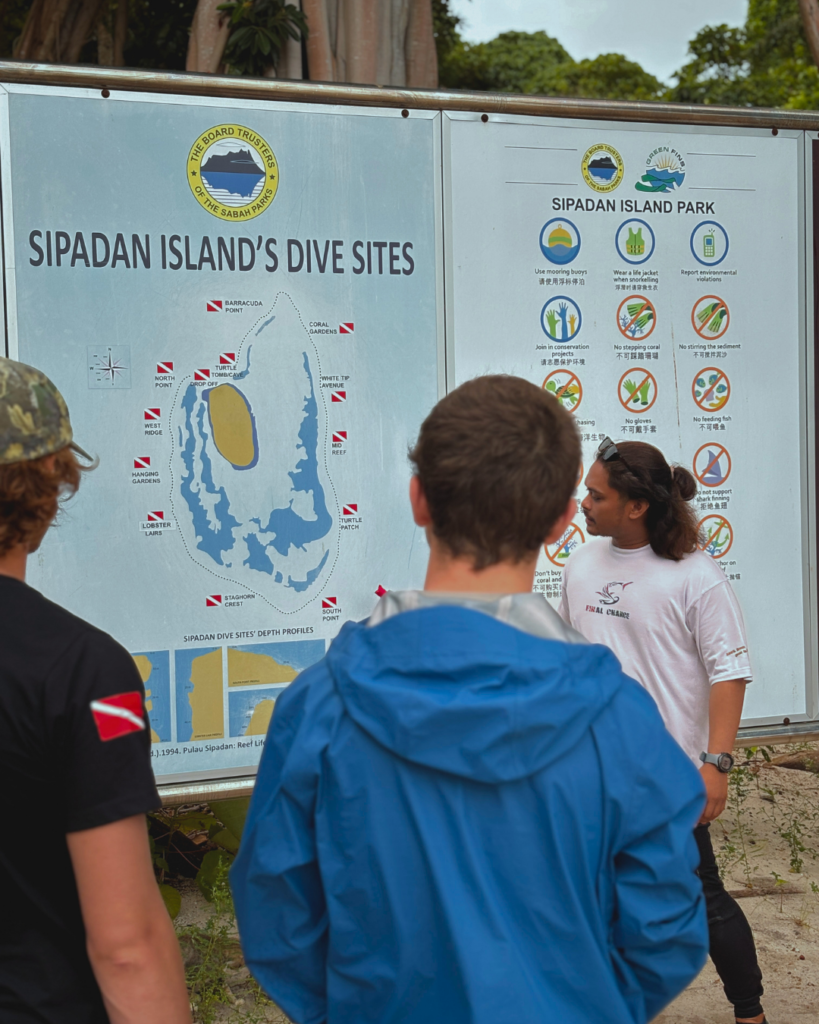
The best dive briefings don’t feel like someone reading from a checklist.
They feel like an invitation.
They build excitement. They help you imagine the dive before it even begins, and they make you feel confident about the plan.
When a guide explains where the current might take you, points out the cleaning station where sharks are sometimes seen, or shares a funny story from the previous day’s dive, they’re doing much more than passing on information.
They’re helping you connect with the dive before you even enter the water.
And that’s something you’ll remember long after you’ve climbed back onto the boat.
A dive briefing ensures everyone understands the dive plan, the conditions, and the safety procedures before entering the water.
Absolutely. Every dive is different, even at familiar dive sites.
Understanding the dive plan, emergency procedures, and feeling confident enough to ask questions.
A buddy check is when you and your buddy inspect each other’s equipment before the dive to catch any issues before entering the water.
Yes. PADI professionals are trained to provide comprehensive dive briefings before every dive.
Of course. In fact, your guide wants you to. A good question on the boat can prevent confusion underwater.
A dive briefing might only take a few minutes, but it sets the tone for the entire dive.
It’s where the plan comes together, where questions are answered, and where excitement meets preparation.
So next time your guide starts the briefing, give them your full attention. You might be surprised by how much more confident—and how much more enjoyable—your dive becomes.
After all, there’s a reason divers have been saying it for generations:
Plan your dive. Dive your plan.
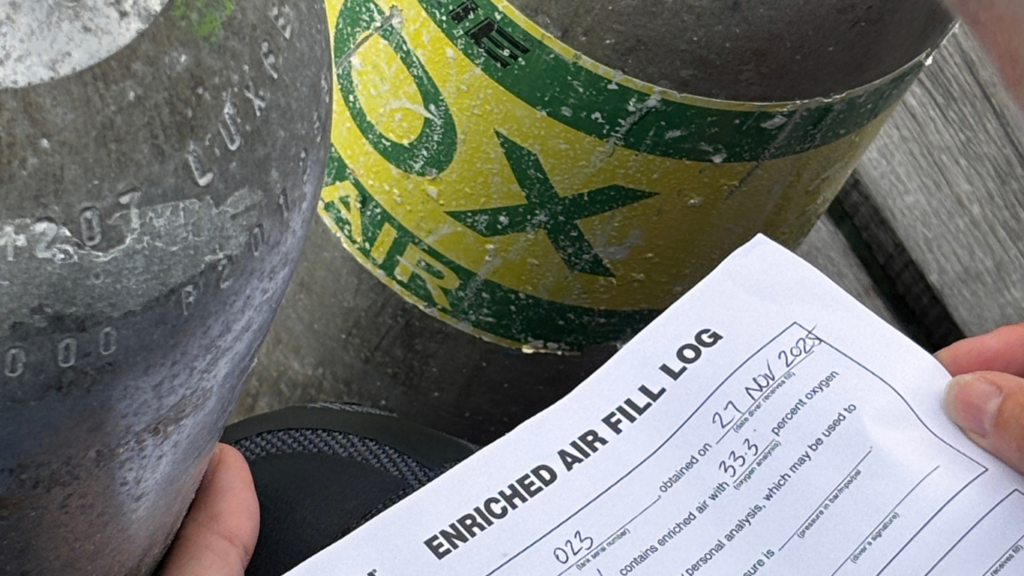
If you’ve ever walked into a dive center and noticed tanks with green and yellow markings, you’re not alone in wondering what they are. You might have heard other divers casually asking for them, talking about Nitrox diving as if it’s the obvious better option. But no one really stops to explain what it actually means, and that’s where confusion begins.
One of the most common ideas beginners pick up is that Nitrox diving gives you longer dives. It sounds logical, and it’s repeated often enough that many divers accept it as fact. The reality, however, is a bit more nuanced, and understanding that difference is what separates a confident diver from a confused one.
Nitrox simply refers to using a breathing gas that contains more oxygen and less nitrogen than regular air. Standard air is made up of about 21% oxygen, while Nitrox blends such as EANx32 and EANx36 increase that percentage to 32% or 36%. That change reduces the amount of nitrogen you inhale during a dive, which directly affects how your body absorbs gases underwater.
When you descend, nitrogen begins to dissolve into your tissues. This is what ultimately limits how long you can stay at a certain depth without needing decompression stops. By reducing nitrogen intake, Nitrox diving slows that process down. However, this is where many divers misunderstand its benefit. Nitrox diving does not automatically make your dives longer in terms of total time. Your actual dive duration still depends heavily on how deep you go and how quickly you consume your air.
What Nitrox diving really extends is your no-decompression limit, giving you more flexibility within safe boundaries rather than unlimited time underwater.
Within Nitrox diving, the most common blends are EANx32 and EANx36, and each serves a slightly different purpose. EANx32 is the most widely used because it offers a comfortable balance between extended no-decompression time and manageable depth limits. It’s often the preferred choice for recreational divers who want a practical advantage without significantly changing their dive planning.

EANx36, on the other hand, reduces nitrogen exposure even further, which can be beneficial in certain scenarios, particularly repetitive diving. However, the higher oxygen content introduces stricter depth limitations. As depth increases, so does the partial pressure of oxygen, and beyond a certain point, it can become unsafe. This is why Nitrox diving is not about going deeper but about optimizing time within shallower, controlled depth ranges.
One of the most important things to understand is that Nitrox does not guarantee longer dives. This misconception often leads to unrealistic expectations, especially among newer divers. The truth is that your total dive time is influenced more by your breathing rate and depth profile than by the gas mix itself.
What Nitrox diving does is extend your no-decompression limit, which becomes particularly useful during repetitive dives. For example, on a multi-dive day, your second and third dives are usually shorter because of residual nitrogen. With Nitrox diving, this limitation is reduced, allowing for more efficient dive profiles. However, if your air consumption is high, you will still end the dive based on your tank pressure, not your theoretical limit.
Nitrox is most beneficial in situations where you are doing multiple dives over a short period, such as on dive trips or liveaboards. It allows you to maintain better bottom times across consecutive dives and can make your overall diving experience more efficient and enjoyable.
However, there are environments where Nitrox diving is not the best option. A clear example is diving in Sipadan, where operations like Scuba Junkie do not allow its use. This decision is based on safety considerations, particularly the presence of down currents. In such conditions, divers can be pulled deeper than planned, and with Nitrox diving, exceeding depth limits increases the risk of oxygen toxicity. Using regular air in these environments provides a wider safety margin and reduces that risk.
The higher cost of Nitrox diving often raises questions, but it becomes easier to understand when you look at what’s involved. Producing Nitrox requires precise gas blending, specialized equipment, and strict safety protocols. Oxygen itself is more expensive than air, and tanks must be properly maintained to handle higher oxygen concentrations. Additionally, dive center staff need specific training to manage the process safely. All of these factors contribute to the increased price, reflecting the extra care and control required.
Nitrox is accessible to most certified divers and is particularly useful for those who dive frequently or travel for diving. Courses offered by organizations like PADI, SSI, and NAUI are usually straightforward and can often be completed in a short time. These courses focus on understanding oxygen exposure, analyzing gas mixes, and planning dives correctly.
For dive professionals, Nitrox diving becomes an additional tool that enhances both safety awareness and teaching capability. It’s not essential for every diver, but it is one of the most practical upgrades available in recreational diving.
Nitrox diving is safe when used correctly, but it requires awareness and discipline. While it reduces nitrogen exposure, it introduces oxygen limits that must always be respected. Divers need to analyze their tanks before each dive, confirm the oxygen percentage, and set their dive computers accordingly. The safety of Nitrox diving depends entirely on proper use, which is why training is essential.
Now that you have a clearer understanding of Nitrox diving, the decision becomes more personal. Does it sound like something that would improve your diving experience, or do you feel more comfortable staying with air, especially in environments where conditions can change quickly?
If you are already Nitrox certified, it’s worth reflecting on how you’ve been using it. Did you fully understand that it doesn’t necessarily extend your total dive time? Or has this explanation helped clarify that difference?
Sometimes, improving as a diver is not about learning something completely new, but about understanding familiar concepts more deeply.
1. What is Nitrox in simple terms?
Nitrox diving is scuba diving using a gas mix with more oxygen and less nitrogen than regular air.
2. Does Nitrox make dives longer?
No, it extends no-decompression limits, but total dive time still depends on depth and air consumption.
3. Is Nitrox allowed everywhere?
No, some locations like Sipadan do not allow it due to safety concerns.
4. Do I need certification for Nitrox?
Yes, a Nitrox course is required to use it safely.
5. Is Nitrox safer than air?
It can reduce nitrogen exposure, but it also introduces oxygen limits that must be managed carefully.
6. Why is Nitrox more expensive?
Because of the cost of oxygen, specialized equipment, and stricter safety procedures.
Scuba diving air consumption is one of the most talked-about — and most misunderstood — topics in recreational diving.
New divers often worry about being the first low on air, while experienced divers sometimes treat low air consumption like a badge of honor. Somewhere along the way, breathing underwater stopped being a learning process and started feeling like a competition.
At Scuba Junkie Sipadan, we see this mindset daily — and it’s something worth changing.
Let’s clear something up.
Scuba Diving Air consumption is not a competition.
And it never should be.
Air consumption is one of the few numbers divers can easily see and compare. Depth, time, and remaining pressure are right there on the gauge — simple, measurable, and tempting to judge.
For new divers, this often turns into anxiety:
For more experienced divers, it can quietly become ego:
But here’s the truth: air consumption alone tells you very little about how good a diver actually is.
One of the biggest misconceptions in scuba diving is that good air consumption comes from “breathing better.” In reality, it’s the result of multiple factors working together, often developed over years.
Overweighted divers work harder to stay neutral. More effort = more breathing. Proper weighting takes time, adjustments, and honest feedback.
A diver swimming vertically creates drag and wastes energy. Efficient trim and buoyancy reduce effort — but they don’t happen overnight.
Different exposure suits, fins, tank sizes, and configurations all affect comfort and workload. New gear often means higher air consumption until the diver adapts.
Current, surge, cold water, low visibility, and task loading all increase breathing. Comparing air consumption from different dives — or different environments — is meaningless.
Stress, excitement, nerves, and even overthinking breathing will increase air usage. Calmness comes with familiarity and confidence, not pressure.
This one matters more than most people admit. A diver who dives every week will almost always breathe less than someone returning after months out of the water — regardless of certification level.
This is the part many people don’t talk about.
Even highly experienced divers:
That doesn’t make them worse divers.
It makes them human.
Good divers don’t aim to “always be perfect.”
They adapt, notice changes, and adjust safely.
Turning air consumption into a competition creates real problems:
Diving should be about situational awareness, buddy communication, and enjoyment — not proving who used the least gas.
Instead of asking:
Try:
Instead of comparing:
Good instructors and guides don’t show off their air consumption.
They use it as a teaching tool, not a flex.
If you’re new to diving and reading this, here’s what you need to hear:
You are learning a completely new way of moving, breathing, and existing in an environment humans were never built for.
Air consumption improves naturally with:
Anyone who tells you otherwise has forgotten what it felt like to be new.
The best diving cultures aren’t built on comparison.
They’re built on patience, humility, and shared curiosity.
So the next time someone surfaces with 100 bar — smile, don’t judge.
And the next time you surface with 50 — know that you’re exactly where you should be.
Because in diving, the goal isn’t to breathe less.
It’s to dive better, safer, and kinder — together.
Improving scuba diving air consumption comes naturally with comfort, experience, and time in the water — not comparison or pressure.