



Mabul night diving begins only a few steps from the Scuba Junkie jetty, but the familiar house reef feels completely different once the sun disappears. Torch beams replace daylight. The sandy bottom becomes a stage for animals that spent the day hidden, and every artificial structure creates another shadow worth investigating.
During the day, Mabul is already famous for macro life. After dark, the same habitats become more mysterious, more focused and somehow even more alive.
From the jetty, you can turn right toward Awas or left toward Froggies. Both sites are close to home. Both combine sand, reef and structures. Yet each creates its own version of a night dive.
Daylight lets divers take in a whole reef at once. At night, your torch narrows the world.
You stop seeing everything and start noticing one thing at a time: a pair of eyes above the sand, the movement of a tiny squid, an octopus changing texture or a nudibranch crossing a surface that looked empty seconds earlier.
This smaller field of view is part of what makes Mabul night diving so immersive. The rest of the ocean disappears beyond the beam, helping divers slow down and concentrate on details.
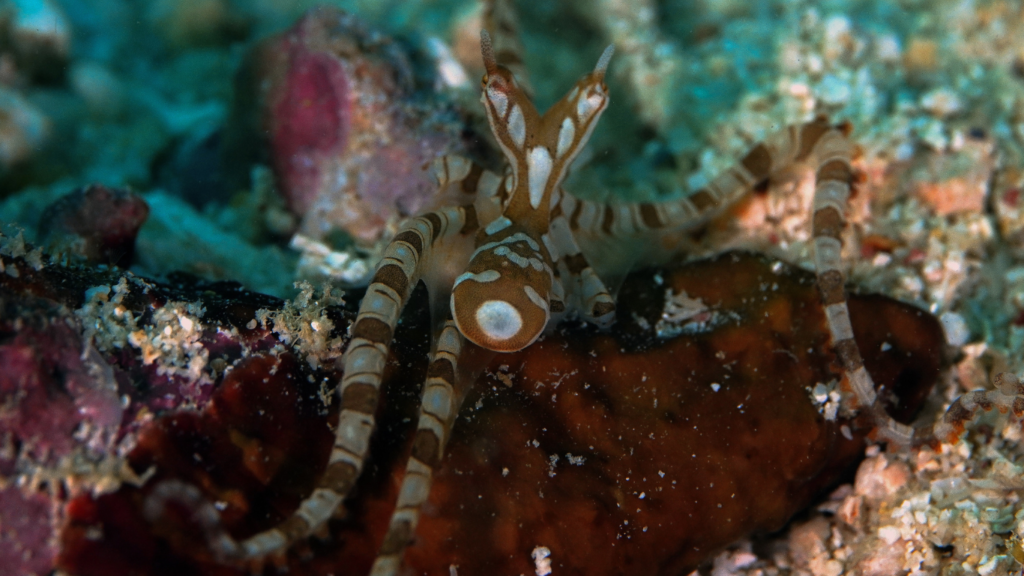
Many animals also change their behaviour after sunset. Some become more active, while others settle into resting places. Cephalopods and crustaceans are frequent favourites, and the sandy habitats around Mabul are ideal for searching carefully rather than covering a large distance.

Awas sits directly in front of the Scuba Junkie dive centre and is reached by turning right from the jetty.
The word awas means caution in Malay. This is the area where boats move in and out, and signs warn them to be careful because divers may be below. Underwater, the site opens across a sandy slope with artificial structures that provide shelter and hunting ground for an extraordinary range of marine life.
During Mabul night diving, Awas can feel like a completely different site from one torch beam to the next. One moment the sand appears still. The next, a guide has found a bobtail squid, cuttlefish, octopus or another perfectly camouflaged animal that was there all along.
Awas is also known during the day for possible encounters with frogfish, ghost pipefish, dragonets, flying gurnards, snake eels, nudibranchs and mandarin fish. At night, the combination of sand and structure makes every slow search feel full of possibility.
Nothing is guaranteed, and that uncertainty is part of the appeal. A night dive is not a checklist. It is a patient search through a habitat that keeps changing after sunset.
Turn left from the Scuba Junkie jetty and you move toward Froggies.
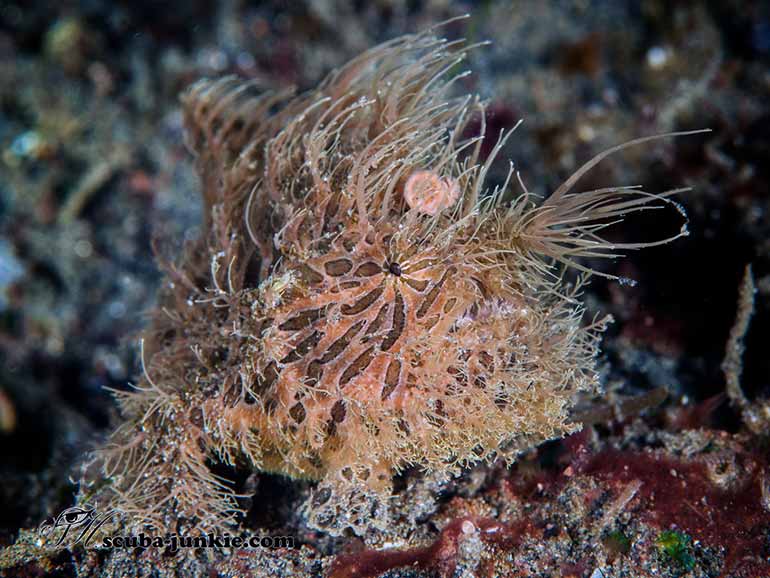
The site received its name during a time when frogfish were especially abundant there. The numbers have changed over the years, and divers should never expect the past to repeat itself exactly. Frogfish are still found, but Froggies remains special for reasons that extend beyond the animal in its name.
The site combines a shallow reef with sand, creating several different places to search during one dive. Where reef meets sandy bottom is often particularly interesting. Animals can hide against coral, settle beside small structures or disappear into open ground through camouflage.
Froggies may reveal nudibranchs, pipefish, scorpionfish, stargazers, crocodilefish, cuttlefish, octopus, bobtail squid and schooling fish. Several sunken boats on the sand add even more habitat to explore.
The shallow profile and variety are part of why Froggies remains a favourite for Mabul night diving. You do not need to travel far or go deep to enter a completely different underwater world.
The honest answer is that every night is different.
Bobtail squid may hover just above the sand before burying themselves again. Reef squid can move through open water. Papuan cuttlefish may change colour and texture as they hunt or react to the light. Coconut octopus and other cephalopods use shells, sand and debris as shelter.
Crustaceans emerge from spaces that look empty during the day. Large nudibranchs move slowly across the reef. Green turtles may be seen resting, and fish settle into crevices or change colour for the night.
On some dives, the most memorable animal is not rare at all. It is simply behaving in a way you have never seen before.
That is one of the best reasons to try Mabul night diving. It is not only a chance to see different species. It is a chance to see familiar marine life differently.
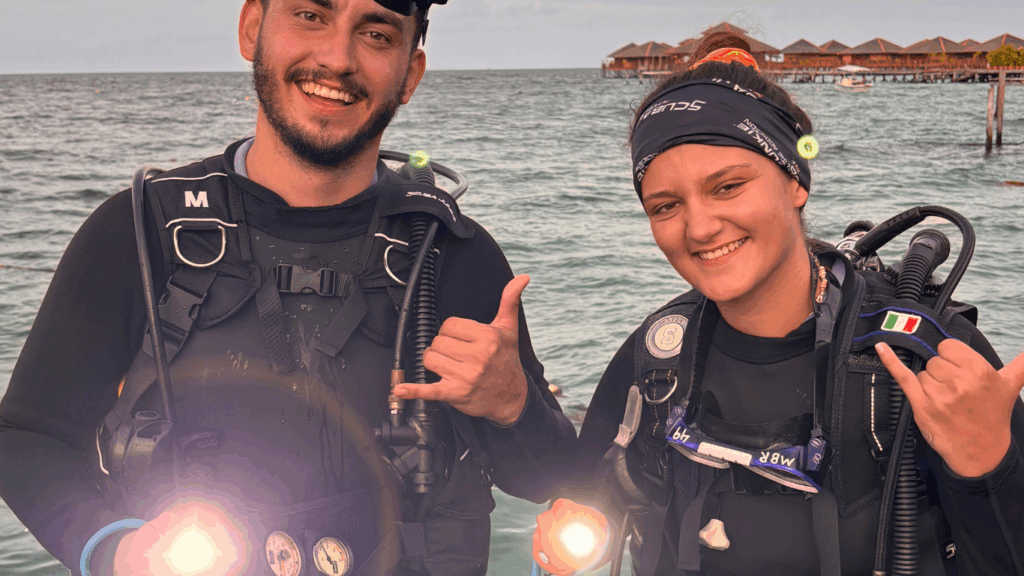
Night dives take place on the Mabul house-reef sites and are guided by one of our dive professionals. Numbers are limited, so guests should check availability with reception during their stay.
Divers need to hold at least an Open Water certification and complete a daytime dive with us first. This gives you time to become comfortable with the equipment, guides and local environment before entering the water after dark.
The dive begins around sunset and must finish by 7:30 pm under the local water-activity curfew. Before entering, the guide explains the route, communication, torch signals, buddy procedures and what to do if anyone becomes separated.
For many guests, the first few minutes feel unusual. The water is familiar, but the darkness changes how distance and direction feel. Once the group settles into the dive, the torch beam becomes less of a limitation and more like a private window into the reef.
The best way to enjoy a first night dive is to remove unnecessary pressure.
Start with a site and equipment you already know. Stay close to your buddy and guide. Move slowly, maintain good buoyancy and avoid kicking up the sandy bottom, which can reduce visibility for everyone.
Torch communication is reviewed before the dive. Divers can illuminate their hand when making a normal signal, and light movements are used for basic communication. Avoid shining a torch directly into another diver’s eyes.
It is also important to respect the animals. A torch is useful for observation, but a bright beam can disturb marine life when held on the same subject for too long. Do not chase an animal, block its path or surround it for a photograph.
Good Mabul night diving feels calm. The group covers less distance, looks more carefully and allows the animals to behave naturally.
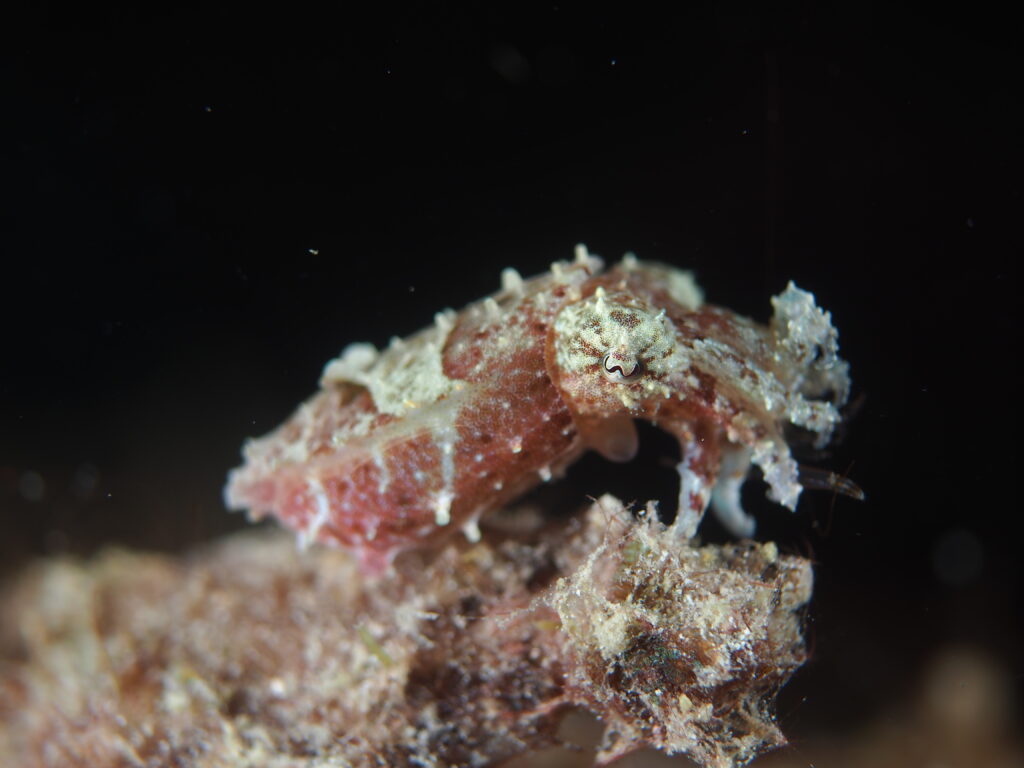
Night diving can be brilliant for underwater photography because the background beyond the torch or strobe often becomes naturally dark. Small subjects stand out, colours return and behaviour can become the main story.
But a camera adds task loading. If it is your first night dive, consider experiencing the site without feeling that every encounter needs to become a photograph.
If you do take a camera, have it prepared before the briefing. Check the battery, memory card, housing and lights while you are still dry. Underwater, maintain buoyancy before concentrating on the subject, give other divers space and avoid repeated flashes when an animal appears stressed or tries to move away.
The best image is never worth damaging the habitat or changing an animal’s behaviour.
After dark, it becomes even clearer how much life depends on habitats that can initially look ordinary.
A sandy slope is not empty. An artificial structure is not only debris or decoration. A shallow reef is not less important because it sits close to a busy island. Each can provide shelter, feeding ground or breeding space for marine life.
Scuba Junkie SEAS works throughout the year on Mabul through turtle conservation, coral restoration, marine-debris removal, research and environmental education. That work supports a larger understanding of the island: diving and conservation cannot be treated as separate stories.
Guests can follow @scubajunkieseas, learn about current activities during their stay and ask how they can take part.
The creatures that make Mabul night diving extraordinary depend on what happens during the day too: how waste is managed, how reefs are treated and whether tourism is willing to protect the place that makes the experience possible.
Night dives are conducted on the Mabul house reef, including sites such as Awas and Froggies, depending on the plan and conditions.
You must be at least Open Water certified and complete one daytime dive with Scuba Junkie before joining a night dive.
All night divers must be out of the water by 7:30 pm because of the local curfew for water-based activities.
Yes, it can be. The dives are guided and take place close to the resort. Tell the dive team if it is your first night dive so they can explain the procedures and help you prepare.
Torch arrangements can be confirmed with reception when booking the night dive. Your guide will explain the lighting and communication procedures before entering the water.
Possible sightings include squid, cuttlefish, octopus, crustaceans, nudibranchs, frogfish, pipefish, turtles and many other nocturnal or resting animals. Marine-life encounters are never guaranteed.
Yes, but make sure you are comfortable with your buoyancy and night-diving procedures first. Prepare the camera before the briefing and avoid disturbing marine life for a photograph.
Awas and Froggies are only a short distance from the jetty, yet they prove that an unforgettable dive does not require a long boat journey.
Sometimes all it takes is sunset, a torch and the decision to look at a familiar reef in a completely different way.
To ask about Mabul night diving during your stay, speak with reception or contact our team.
📧 sipadan@scubajunkie.com
📱 WhatsApp: +60 19-640 0116